Georgia creates a development corporation to support GEL 40 billion of investment over ten years
Direct lending, equity stakes, large energy projects: a new public tool to accelerate private investment
by
Adrien Boucher
The Georgian government has unveiled the Georgia Economic Development Corporation, replacing Enterprise Georgia and aiming to support up to GEL 40 billion of projects over ten years through loans, equity and investment funds. What it means for the country and for investors.
On 20 October, the Georgian government unveiled the Georgia Economic Development Corporation, a new state body tasked with supporting investment in the country. Its goal is ambitious: to support up to GEL 40 billion of private investment over the next ten years, equivalent to around USD 15 billion at current rates.
The corporation was presented in the presence of Prime Minister Irakli Kobakhidze and Deputy Prime Minister and Economy Minister Mariam Kvrivishvili. It is headed by Irakli Gabriadze.
The closest comparisons are national development banks and investment vehicles such as Germany's KfW, France's Bpifrance or, in the Gulf, the state investment platforms that back strategic sectors. Georgia is creating a tool of this kind on its own scale. For a country of 3.7 million people, the ambition is considerable.
A reform in the making since spring
The 20 October announcement was no surprise. The Prime Minister had announced the corporation in April 2026, together with a separate investment agency specifically tasked with attracting foreign investors. Irakli Gabriadze was appointed to head it in June. He had been Deputy Director General of Enterprise Georgia since 2020: a choice of continuity, ensuring the agency's accumulated experience is not lost.
Its mandate covers industry, energy, logistics and infrastructure. Beyond financing, the corporation will have an analytical role: identifying promising sectors, preparing projects and mobilising market tools such as syndicated loans and bond issues, which are still underdeveloped in Georgia.
Four institutions under one roof
The new corporation replaces Enterprise Georgia, the agency that has funded entrepreneurs until now, and takes over the functions of the Energy Development Fund and the Georgia Development Fund. The idea is simple: bring tools that were previously scattered under one management.
Until now, an entrepreneur seeking public support had to knock on different doors depending on the type of project. From now on, there will be a single point of contact. That saves businesses time, and it sends a signal of simplification to foreign investors, who like to know whom to talk to.
It will also have a much wider range of instruments. On top of the grants and concessional loans offered by Enterprise Georgia, it will be able to provide direct loans, take equity stakes in companies, invest in private equity funds and offer factoring. And its scope is no longer limited to small and medium-sized businesses: it extends to large strategic and energy projects.
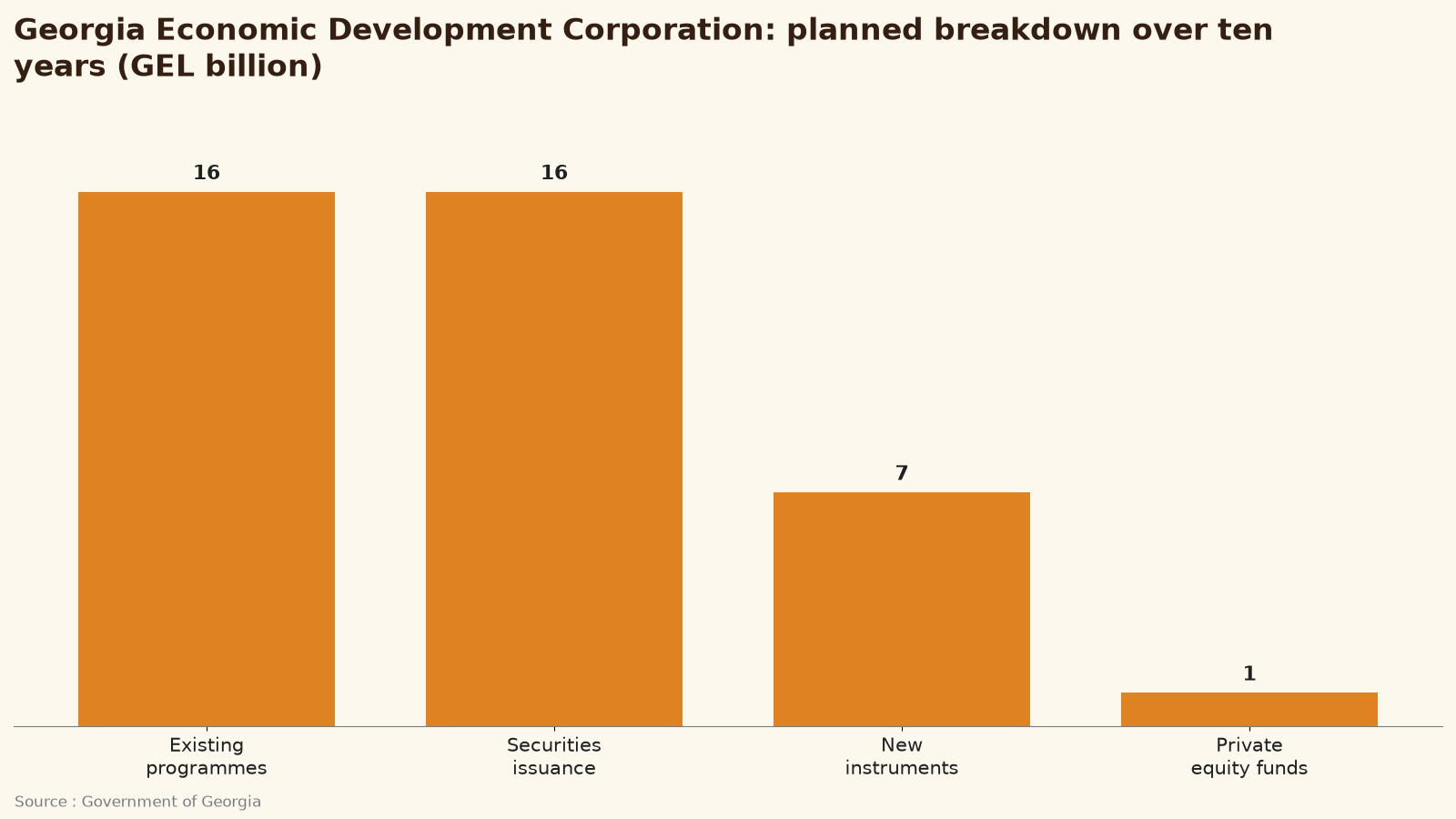
The GEL 40 billion is split between existing programmes, securities issuance, new instruments and investment funds.
Where the money comes from
The plan is to support GEL 16 billion of projects through existing programmes, provide GEL 7 billion through new instruments, take part in GEL 16 billion of securities issuance and invest GEL 1 billion in private equity funds. Funding will come from the state budget, the credit guarantee system and international financial institutions.
Why now
The timing is no accident. Foreign direct investment in Georgia reached around USD 1.9 billion in 2025, up 19% according to revised national statistics. But more than 80% of that came from profits reinvested by companies already in the country, rather than from new investors. And in the first half of 2026, foreign investment fell by 22% to USD 750 million amid a tenser international climate. China became the country's largest foreign investor in the second quarter.
In other words, the economy is running well, driven by consumption, tourism, exports and local companies. But the country needs new large-scale projects to sustain growth over time. That is precisely the corporation's role: to bring those projects forward and share the risk with private investors.
The state can afford it. As we explained in our analysis of Georgia's 2027 budget, public debt is capped at 31.6% of GDP and tax revenue is ahead of target. A country with little debt can invest in its growth without putting its finances at risk.
Invest in a developing country
A dynamic economy, light taxation, direct ownership: let's talk about your Georgia project in 30 minutes.
The government points to the results of the agency it replaces. Between 2014 and 2025, Enterprise Georgia programmes supported more than 20,000 entrepreneurs, attracted GEL 8.5 billion of investment and created around 90,000 jobs.
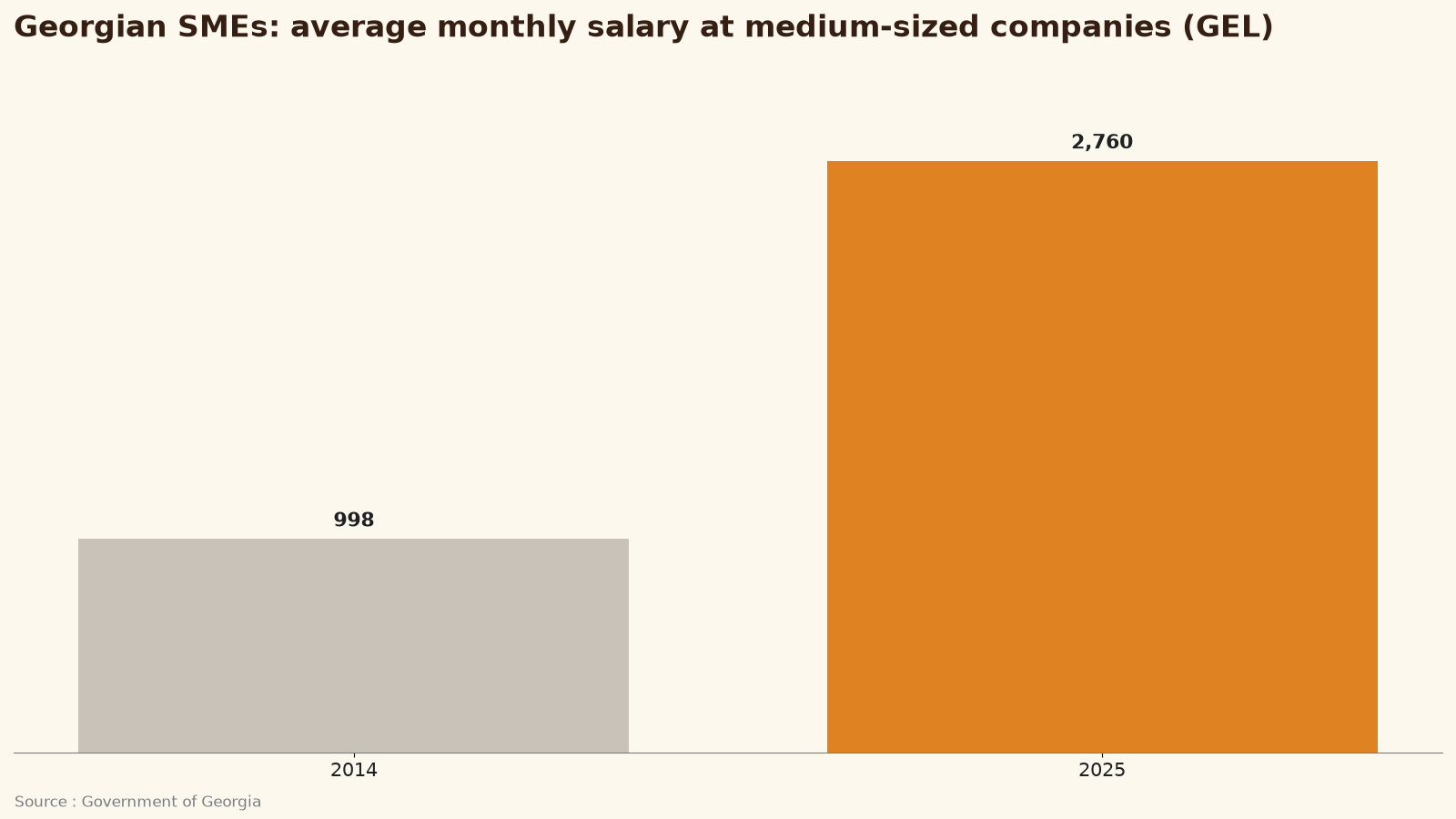
Over the same period, employment in small and medium-sized businesses rose from 405,000 to 544,000, their output from GEL 14.8 billion to more than GEL 54 billion, and their exports from USD 1.3 billion to USD 2.7 billion. The average salary at medium-sized companies rose from GEL 998 to GEL 2,760 a month: it almost tripled in eleven years.
The average salary at medium-sized companies almost tripled between 2014 and 2025.
Tourism has also benefited from these programmes. Enterprise Georgia's hotel scheme, which co-finances hotels in the regions outside Tbilisi and Batumi, has supported 136 projects representing more than 3,800 rooms and 3,300 jobs. The aim was to develop tourism across the whole country, beyond the two main cities. Batumi, for its part, grew without this public support, driven by private investment and foreign demand.
These figures do not tell the whole story: SME growth also owes a lot to the general momentum of the economy. But they show that a public investment support scheme can have a tangible impact in a country of Georgia's size.
An ambitious target, with conditions
Analysts welcome the logic of the reform but remain cautious about the target. Enterprise Georgia attracted GEL 8.5 billion in eleven years. Aiming for GEL 40 billion in ten means changing scale and, above all, method: moving from small grants to large projects financed through equity or syndicated loans.
That means the corporation will take on more risk than an agency that mainly handed out subsidies. Everything will depend on the quality of project selection. The experience of development institutions elsewhere is clear: what makes them succeed is not the size of their funds but their ability to say no to weak proposals.
The corporation already manages its first assets. Since 1 October, it has owned the Poti Free Industrial Zone on the Black Sea: more than one million square metres of land near the port, with exemptions from profit tax, VAT and customs duties on goods for export. The zone fell short of expectations under its previous investors. It will be one of the first tests of the corporation's ability to develop assets, not just hold them. It also sits on the Black Sea coast that the Middle Corridor is transforming, as we described in our article on the Anaklia deep-sea port, which is now under construction.
The Middle Corridor, the strategic prize
To understand the corporation's ambition, look at the map. Georgia sits on the Middle Corridor, the trade route linking China and Europe via Kazakhstan, the Caspian Sea, Azerbaijan, then Georgia and the Black Sea, bypassing Russia. Since 2022, the route has attracted enormous interest. In the first eight months of 2026, freight volumes along the whole corridor rose by 22% and container traffic by more than 50%. Transit through Georgia doubled between 2018 and 2025, to 4.6 million tonnes. The World Bank estimates volumes could almost triple by 2040.
To benefit, Georgia is investing in infrastructure. The flagship is the Anaklia deep-sea port on the Black Sea, where construction entered an active phase in spring 2026. The government has decided to keep control of the port infrastructure, and marine works have been awarded to Belgian group Jan De Nul. The first phase is due to open in 2029. Ports, logistics zones, energy, roads: these are exactly the kinds of projects the development corporation is meant to support alongside private investors.
Energy is the other priority. Last summer's power outages highlighted the grid's fragility, and folding the Energy Development Fund into the corporation should speed up hydro, wind and solar projects. An economy that produces more of its own energy depends less on imports, and therefore on external price shocks.
Why it matters for property investors
At first sight, an economic development corporation has little to do with real estate. In reality, the link is direct.
A country that mobilises tens of billions to finance its businesses, infrastructure and energy creates activity, jobs and income. Salaries that triple mean households that can afford higher rents, and then buy. They are the ones who ultimately drive housing demand, both for purchase and for rent. And a state that structures its support for investment sends a signal of stability to foreign capital.
Batumi's recent history illustrates this well. In around fifteen years, the city has gained an international airport, an extended seafront boulevard, a modernised port and a wave of new hotels. Each new piece of infrastructure attracted visitors, businesses and residents, and property prices followed. The large projects the corporation is set to support in logistics, energy and industry follow the same logic nationwide: where jobs and infrastructure arrive, housing demand rises.
The announcement adds to a series of positive signals in recent weeks: record foreign exchange reserves and surging exports, a 2027 budget with debt capped at 31.6% of GDP, and a National Bank forecasting a strong lari until 2029. In Batumi, we see net rental yields of 8 to 12% and prices rising by 15 to 20% a year.
And for entrepreneurs?
The corporation is also directly relevant to clients considering starting a business in Georgia. A single point of contact, a wider range of instruments and a scope extended to large projects: the framework is becoming clearer. We set out the steps in our article on setting up a company in Georgia. Reinvested profits are not taxed, and registration takes just a few days.
Tbilisi and the Holy Trinity Cathedral. The new corporation is set to support projects across the country. Photo: User:Ggia, CC BY-SA 3.0, Wikimedia Commons
What to watch
The corporation's timetable and detailed operating rules, which have not yet been disclosed. The actual launch of the first instruments, the first large projects financed, the future of the Poti free zone, and the involvement of the international financial institutions announced as partners.
Conclusion
With its new development corporation, Georgia is giving itself the means to invest on a different scale. The target is ambitious and the approach will have to prove itself. But the direction is clear: a country investing in its businesses, infrastructure and energy, with sound public finances. For investors looking at the country over ten or fifteen years, this is exactly the kind of structure that matters: the one that prepares tomorrow's growth. To find out more, visit our page on investing in Georgia.
Want to invest in a country preparing its growth?
A dynamic economy, light taxation and property ownership open to foreigners: Georgia ticks many boxes. If you are interested, let's take 30 minutes to talk. The first conversation comes with no commitment.