The Complete Guide to Legal Structures, Taxes and Opportunities
by
Adrien Boucher
Far from an opaque tax haven, Georgia represents Europe's most efficient business jurisdiction in 2026. From the 1% Individual Entrepreneur (IE) regime to the 0% Estonian-style corporate tax model for LLCs, this institutional guide breaks down corporate setups, Special IT Virtual Zones, Free Industrial Zones, and the real cost of local talent acquisition.
Why Georgia has become a serious business jurisdiction
Georgia is not a tax haven in the sense of an opaque jurisdiction that conceals capital. It is something more interesting and more durable: a country that has deliberately chosen, since the early 2000s, to build its economic competitiveness on fiscal simplicity, administrative speed, and openness to foreign capital.
The result is an environment that stands in sharp contrast to what you encounter in Western Europe. No employer social contributions on salaries. No inheritance tax. No wealth tax. A corporate income tax that only applies to profit distribution. Company registration completed in 24 to 48 hours. Special tax regimes for sole traders, IT companies, free zone enterprises and multinationals. Georgia consistently ranks among the world's most reformed economies according to the World Bank, with a business registration procedure that can be completed in 24 to 48 hours for a fee of 100 GEL, roughly 35 euros.
This guide sets out the options available, their respective tax frameworks, their advantages and their limitations, so you can identify the most appropriate structure for your situation before taking action.
Georgia's core tax framework: what you need to understand first
Before looking at the legal structures in detail, you need to grasp the mechanics of Georgian taxation, which differs fundamentally from the French or Belgian model on several key points.
Territoriality for individuals
Georgia applies a territorial approach for individuals: a resident is exempt from income that has no Georgian source. In practice, salary and fees corresponding to work physically performed in Georgia constitute a Georgian source even if the paying party is foreign.
Concretely: if you are a Georgian tax resident and receive income from activities carried out outside Georgia, that income is not taxable in Georgia. This is the principle that makes the country particularly attractive for international entrepreneurs and digital nomads.
Corporate income tax: the Estonian model
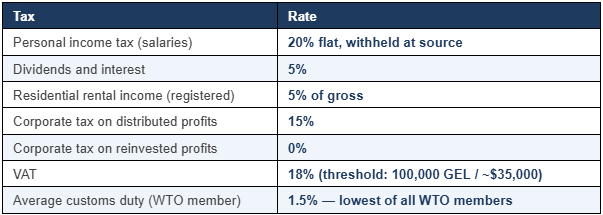
Since 2017, Georgia has applied a model inspired by the Estonian system. Corporate income tax is not levied on profits generated, but only when they are distributed as dividends. The applicable rate is 15% on distributed profits. Profits reinvested within the company are not taxed.
This is a fundamental difference from the French system where corporate tax is deducted each year from net profit regardless of how those profits are used. In Georgia, a company that reinvests its earnings grows without paying tax on them. It only pays when it distributes to shareholders.
Core tax rates at a glance
What does not exist in Georgia
There are no meaningful employer social contributions beyond the mandatory pension scheme. No stamp duties, no inheritance tax, no wealth tax. For an entrepreneur coming from a high-social-contribution country like France, where employer charges represent 40 to 50% of gross salary, the Georgian reality fundamentally changes the equation for hiring.
The two most common structures: IE and LLC
The Individual Entrepreneur: simplest and most tax-efficient for freelancers
The Individual Entrepreneur (IE) is the Georgian equivalent of a sole trader or self-employed status. It is the most widely used structure by freelancers, digital nomads, consultants and small business owners who want to operate in Georgia with minimal administrative burden.
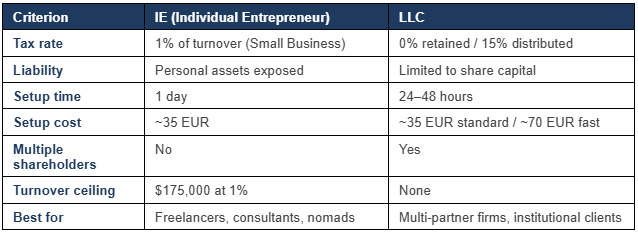
The applicable tax regime is known as Small Business Status. It allows a sole trader to pay just 1% of annual turnover in tax, with no further profit tax, up to a ceiling of 500,000 GEL per year (approximately $175,000). Above that threshold, the rate rises to 3%.
To put that in concrete terms: a consultant billing $100,000 in services over the year pays $1,000 in tax. No corporate tax, no employer contributions, no VAT below the threshold, and no mandatory pension contributions beyond the basic scheme. The total tax burden is between ten and twenty times lower than what an equivalent profile would carry in France or Belgium.
The registration procedure is straightforward: present your passport at a Public Service Hall, complete a form, and receive your tax identification number. The process can be done in a single day, and registration can also be completed remotely through a representative with power of attorney, making the structure accessible without travelling to Georgia.
The main limitation of the IE structure is the absence of liability protection. As a sole trader, your personal assets are not separated from business debts. That said, any party seeking to pursue you would have to do so through Georgian courts, which in practice represents a significant obstacle for foreign creditors. For low-litigation-risk activities, this is not a critical limitation. For activities involving significant contractual commitments, the LLC is more appropriate.
The LLC: the reference structure for businesses
The LLC (Limited Liability Company) is the Georgian equivalent of a private limited company. It is the most widely used corporate form for businesses that want a structure with its own legal personality, liability protection for shareholders, and stronger commercial credibility.
A Georgian LLC can be founded by one or more shareholders, foreign or Georgian, with no restrictions on the nationality or residency of founders. The minimum share capital is symbolic, set at 1 GEL. Registration is handled through the NAPR (National Agency of Public Registry) and can be finalised in 24 to 48 hours. Registration costs 100 GEL on the standard track, or 200 GEL for accelerated one-hour processing.
On the tax side, an LLC is subject to the Estonian corporate model described above: 0% on reinvested profits, 15% on distributed profits. Dividends paid to Georgian resident individuals attract 5% withholding tax. Dividends paid to non-residents are also taxed at 5%, subject to applicable double tax treaties.
The LLC provides several advantages the IE cannot. It has distinct legal personality, protecting shareholders' personal assets. It accommodates multiple shareholders with differentiated rights. It is better suited to institutional client relationships and to banks that prefer dealing with an incorporated entity. And it enables multi-tier structures, including holding arrangements.
Creating an LLC requires appointing a director, who may be a foreign non-resident. It is not necessary to appoint a Georgian director or maintain a permanent physical presence to register the company, though a Georgian address is required for registration purposes.
IE vs LLC — quick comparison
Other available legal forms
Several additional structures exist and are worth knowing about, without requiring exhaustive treatment here.
The Joint-Stock Company (JSC) is the equivalent of a public limited company. It suits businesses planning capital raises through share issuance, stock exchange listing, or broad shareholder bases. Its governance is more complex and its reporting obligations more demanding than an LLC.
General Partnerships and Limited Partnerships have limited use in an international optimisation context but can be relevant for certain real estate investment or fund structures.
A Branch Office allows a foreign company to establish a legal presence in Georgia without creating a separate entity. It is useful for international groups that want to operate locally while maintaining their parent company's legal structure. Branches are fiscally transparent: their income is consolidated with the parent in the home jurisdiction.
Special tax regimes: where the opportunities become genuinely compelling
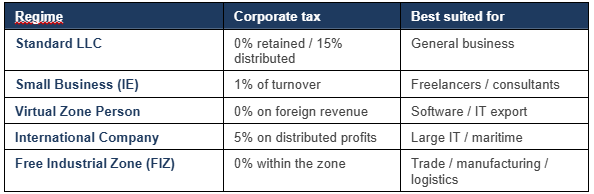
Virtual Zone Person status: 0% corporate tax for IT companies
Virtual Zone Person status allows companies developing software and information technologies in Georgia to export their products internationally with a 0% corporate income tax rate on revenue generated outside Georgia. VAT is also exempted on exports of technology developed under this framework. Dividends distributed by a Virtual Zone company remain subject to 5%.
This status is particularly well suited to digital agencies, software publishers, developers, SaaS companies, and any IT operator working primarily for foreign clients. There is no minimum foreign revenue threshold, but the core activity must genuinely be the creation of information technology, not simply the provision of general services.
Obtaining the status requires filing an application with the Georgian government through a straightforward administrative procedure, with no special licence or permit required beyond standard company registration.
International Company status: for larger IT and maritime structures
International Company status is reserved for larger enterprises in the information technology and maritime transport sectors. It provides corporate tax of 5% on distributed profits, VAT exemption on exported services, 0% property tax on assets used for permitted activities, and an income tax rate of 5% on employee salaries instead of the standard 20%.
That last point is particularly significant for companies building local teams. Reducing income tax on salaries from 20% to 5% represents a substantial saving on total payroll costs, which can be partly channelled into net compensation to attract stronger talent.
Stop losing 50% of your corporate wealth to obsolete Western tax regimes
In 2026, building a scalable international business shouldn't involve penalizing your capital or paying heavy employer social contributions. Request an end-to-end structuring consultation with FFI to establish your compliant, high-yield holding in Georgia.
Free Industrial Zones (FIZ): the structure for international trade and manufacturing
What a free zone is in Georgia
Free Industrial Zones (FIZ) are special economic areas within Georgian territory, with defined boundaries, where specific tax and customs conditions apply. The main zones are located in Poti (Black Sea port city), Kutaisi, and Tbilisi. A new FIZ in the Sagarejo region is expected by 2026.
Companies registered in a FIZ benefit from full corporate income tax exemption on activities conducted within the zone, 0% VAT on imports into and exports from the zone, exemption from customs duties on goods imported into the zone, and 0% property tax on installations and equipment within the zone.
Trade between a free zone company and a company on standard Georgian territory is taxed at 4% of invoice value, allowing domestic market transactions while preserving the bulk of the fiscal advantages.
Who the FIZ is designed for
FIZ structures are built for specific activities: export-oriented manufacturing, international merchandise trading, logistics and warehousing, and regional distribution. The companies best suited to this regime are those that import goods for processing or storage before re-export, those operating in international logistics and freight, and those leveraging Georgia's geographic position between Europe and Asia within the Middle Corridor framework.
Pure service providers generally cannot access FIZ fiscal benefits. For software and digital service companies, Virtual Zone Person or International Company status is more appropriate.
Entry costs are accessible: a virtual office in a free zone starts from around $500 per year, and physical space is available from approximately $10 per square metre for industrial units.
The real cost of an employee in Georgia
This is one of the most compelling arguments for entrepreneurs considering building a local team.
The average monthly salary in Georgia stood at 2,466 GEL in Q4 2025, approximately $870 per month. The IT sector recorded the highest average salary in the Georgian economy, at around 4,433 GEL per month, approximately $1,560.
Employee income tax is a flat 20% rate withheld at source by the employer. There are no significant employer social contributions beyond the mandatory pension scheme contribution, which represents 2% of gross salary on the employer side. No unemployment insurance, no healthcare contribution, no other social levies apply to the employer.
To frame this concretely: a competent web developer in Georgia can be recruited for $1,500 to $2,000 gross per month. Total employer cost, adding the 2% pension contribution, sits at $1,530 to $2,040. In France, an equivalent developer profile costs the employer between 4,000 and 6,000 euros gross per month once employer contributions are factored in. The difference is a factor of three to four.
This differential does not imply lower quality. Georgia produces thousands of graduates each year in computer science, economics and foreign languages. English proficiency in Tbilisi's professional sector is high. And Georgian talent in skilled sectors has earned a reputation for productivity and reliability among international companies that have chosen to build there.
Accounting and administrative obligations after registration
Setting up a company in Georgia is fast and inexpensive. Keeping it compliant requires some regular obligations worth planning for in advance.
For an IE under the Small Business regime, tax declarations are monthly and filed online through the Georgian tax authority portal. A Georgian eSIM or phone number is needed to access the online tax portal. Bookkeeping can be kept simply and outsourced to a local firm for generally between 120 and 150 euros per month.
For an LLC, obligations are slightly more structured: monthly VAT filings if the threshold is met, salary withholding tax filings where applicable, and an annual profit declaration. A Georgian accountant is strongly recommended; fees for a modestly sized company typically run between 150 and 250 euros per month depending on complexity.
Georgia has an extensive network of double tax treaties covering many countries, including France, Belgium, Switzerland, Germany, the United Kingdom and most OECD members. These treaties determine in which jurisdiction income is taxable and allow tax residents of signatory countries to avoid double taxation.
Choosing the right structure for your situation
The answer depends on several variables that should be analysed before reaching a decision. Here is a clear decision framework:
If: You are a freelancer, consultant or independent with turnover below $175,000, no employees, and low litigation risk.
→ IE under Small Business Status — simplest, least costly, most tax-efficient.
If: You run a business with multiple shareholders, employees, institutional clients requiring a legal entity, or significant contractual commitments.
→ LLC — the appropriate corporate structure.
If: Your activity is software or IT product development for export.
→ LLC + Virtual Zone Person status — 0% corporate tax on foreign revenue.
If: Your activity is international merchandise trading, logistics or export-oriented manufacturing.
→ LLC registered in a Free Industrial Zone — full corporate tax exemption within the zone.
If: You run a large-scale IT operation with a significant local team.
→ International Company status — reduces employee income tax from 20% to 5%.
What this means for real estate investors
One point that is frequently overlooked deserves explicit mention for real estate investors operating in Georgia through FFI. Setting up a Georgian LLC to hold real estate assets offers real fiscal and operational advantages.
Rental income received by a Georgian LLC is subject to corporate tax at the point of distribution: 15% when dividends are paid out. Profits retained within the company to fund further acquisitions are not taxed. Property tax in Georgia is low, with a maximum rate of 1% of cadastral value annually, often well below market value.
For an investor holding multiple properties who wants to reinvest rental income into new acquisitions without being taxed on those revenues as they flow, the Georgian LLC provides a particularly efficient long-term structure. This is a tool we help our clients set up correctly at FFI, in coordination with trusted Georgian lawyers and accountants.
In summary
Georgia offers in 2026 one of the most business-friendly environments in the world for setting up and operating a corporate structure. Fast registration, low-cost taxation on retained profits, no significant employer contributions, special regimes for IT and international trade, and industrial free zones for production and logistics: the picture is coherent and well documented.
But setting up a structure in Georgia without understanding the subtleties of the tax regimes, the monthly filing obligations, the double tax treaties applicable to your country of residence, and the economic substance requirements needed to validate certain statuses carries real risk of structuring something incorrectly.
The right structure depends on your activity, your tax residency, your wealth objectives and your operational constraints. This is the analysis we conduct with our clients, in coordination with the appropriate local professionals.
Looking to set up a structure in Georgia or understand which form fits your situation?
FFI guides clients through the setup of their Georgian structures, working alongside trusted lawyers and accountants. Schedule a call with our team.








.png)