After exiting Bali in 2021 due to leasehold yield compression, FFI returns in 2026. The unexposed east coast corridor of Amed introduces a game-changing asset class: boutique beachfront villas (starting at €105,000) held securely under a 100% foreign-owned corporate structure (PT PMA with HGB title up to 80 years) with all company setup fees covered by FFI.
FFI and Bali: a story that resumes where it left off, but on better terms
FFI launched its Bali operations in 2017. For four years, we guided clients through this market, monitored its evolution closely, and built ground-level knowledge that few French-speaking operators can genuinely claim. In 2021, we made a deliberate decision: to stop presenting Bali to our clients.
Not because the island had lost its appeal. Because market conditions had shifted in ways that no longer met our criteria. Rental yields had compressed. The market had absorbed a wave of leasehold construction that had densified supply across the most popular zones. And on leasehold, the combination of a finite duration and tightening yields no longer produced a strong enough equation for us to endorse with a clear conscience.
We are returning to Bali in 2026. But this time with an argument we did not have during our first run: a freehold structure via PT PMA, a location that has not yet reached saturation, and prices that reflect the zone's potential rather than its media overexposure.
What changed: the question of title
Leasehold vs freehold: the difference many sellers avoid explaining
The large majority of properties sold to foreigners in Bali are sold as leasehold, meaning a fixed-term lease contract. This is a perfectly legal structure, well-documented when correctly drawn up, and can be financially interesting in certain configurations.
But leasehold has a constraint every serious investor must grasp before buying: the lease ends. When it expires, the property reverts to the landowner. Reselling a leasehold asset becomes progressively more difficult as the remaining years diminish. And passing an asset to children or heirs when the usage rights expire at a fixed future date is, by definition, constrained.
Under Indonesian law, only Indonesian nationals can legally hold a title in full ownership, known as Hak Milik. Foreigners cannot purchase land in their own name. This is mandated by Indonesian agrarian law. Arrangements through local nominees are illegal and unenforceable in court. Since October 2025, Indonesian authorities have intensified scrutiny of these informal structures, with cases of frozen assets and voided contracts on record.
The legally secure, recognised solution under Indonesian law for a foreigner to hold durable property rights in Bali is the PT PMA.
The PT PMA: what it is in concrete terms
A PT PMA (Perseroan Terbatas Penanaman Modal Asing) is an Indonesian limited liability company with foreign participation. It is the principal legal vehicle through which foreigners can hold property rights in Indonesia beyond what an individual can access in their own name.
A PT PMA can acquire land under an HGB title (Hak Guna Bangunan, Right to Build), valid for 30 years and renewable, with a total possible duration of up to 80 years structured across three periods of 30, 20 and 30 years. This title can be mortgaged, sold and transferred. It is the industry standard for corporate land control in Bali.
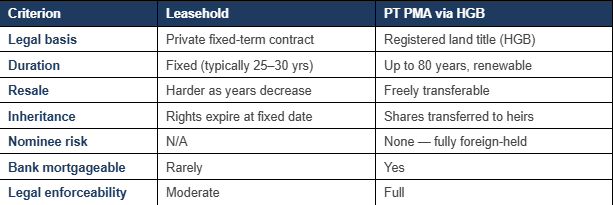
What this means for an investor: the asset is held by a company in which you are a shareholder. You control the company, therefore you control the asset. Unlike leasehold, which is a private fixed-term contract, HGB title via PT PMA is a registered land title, enforceable against all parties, which can be passed to heirs through the transfer of company shares.
Under the Omnibus Law framework and the 2025 positive investment list, 100% foreign ownership is permitted for most real estate, tourism and hospitality classifications. The PT PMA is not a legal workaround. It is the vehicle legally designated by Indonesian law for foreign investors who want genuine legal security over their assets.
Since October 2025, BKPM regulation 5/2025 has reduced the minimum paid-in capital to create a PT PMA from 10 billion to 2.5 billion rupiah, approximately $150,000. This is the capital that must be deposited into the company's Indonesian bank account upon incorporation.
On the Amed project presented here, PT PMA incorporation fees are covered by FFI. This is a concrete advantage that reduces the real entry cost for our clients.
Leasehold vs PT PMA (HGB) — key differences
Amed, Karangasem: Bali's east coast before it looks like everywhere else
A location serious investors are watching now
Amed sits roughly ninety minutes from Ngurah Rai International Airport. Far from the gridlock of Canggu and the noise of Seminyak. Also far from the prices that have made those zones progressively less interesting for an investor seeking residual value.
The Karangasem region, of which Amed is the coastal flagship, combines several characteristics that set it apart from the southern part of the island. The dive sites around the USAT Liberty wreck at Tulamben, a few kilometres away, rank among the most celebrated in Southeast Asia. Mount Agung, Bali's highest volcano, dominates the skyline and creates volcanic scenery the southern coast simply cannot offer. The royal temples of Karangasem, inland waterfalls, and an authentic atmosphere that has so far resisted mass-tourism overexposure complete a destination profile that draws a high-end international traveller looking for something other than Instagram Bali.
The unspoilt beach, Amed's preserved coastline, and the visual depth between the Bali Sea and the coral floor: this is an experiential and visual value proposition that translates directly into occupancy rates for quality accommodation in this zone, without the competitive pressure bearing down on the south.
Amed's infrastructure is developing progressively: improved road access, an upgrading of the hotel and restaurant offer, and growing recognition in international travel media. These are precisely the early-phase signals we have learned to read over the years.
The Amed project: what you are buying
A boutique villa collection with 180-degree uninterrupted ocean views, delivery October 2027
The project we are offering in Amed is a boutique collection of villas in two typologies, two-bedroom and one-bedroom loft, designed around one architectural principle: every villa has an uninterrupted 180-degree ocean view. The masterplan was specifically conceived to ensure no villa obstructs the view of another. This is a constraint that many coastal projects announce without actually delivering.
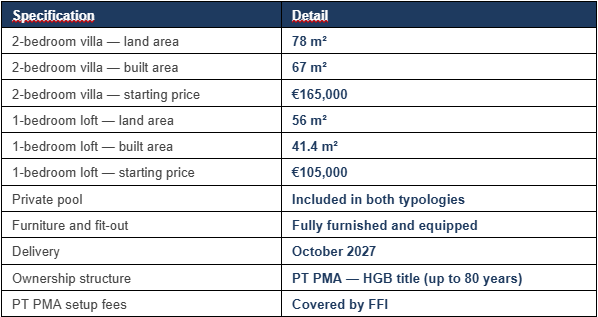
Project specifications
Both typologies are delivered fully furnished and equipped, ready for rental from the day of key handover. The ownership structure is a PT PMA holding HGB title: 80 years of renewable land rights. This is what the market correctly describes as freehold in the context of Bali projects available to foreign buyers, and it is the most legally robust structure available to non-Indonesian residents.
Bypass the leasehold trap: own your land securely in Bali's last authentic corridor
Stop investing in temporary rental contracts. Secure a cross-generational, transferable corporate asset with full legal protection. Request the complete Amed technical brochure today.
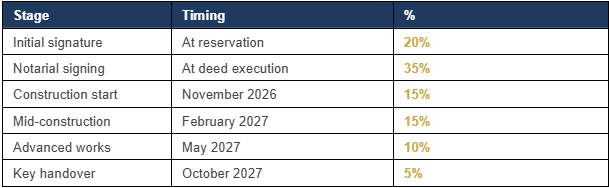
Payments are secured through a notarised escrow account, ensuring that funds are released to the developer only as each corresponding construction milestone is reached.
This notarial escrow mechanism is concrete buyer protection. It is not universal on the Balinese market, and its presence in this project is a meaningful signal of developer seriousness.
Why now, and not later
Three years ago, we would not have presented this project to our clients. Not because Bali lacked interest, but because the conditions we require were not in place.
The combination that brought us back to this market is specific. A freehold structure via PT PMA, giving the investor legal security and inheritability that leasehold cannot offer. A location in an emerging zone whose entry prices still reflect future potential rather than established notoriety. An entry price below €170,000 for a two-bedroom villa with a private pool and ocean views. And a fully furnished, turnkey delivery in October 2027.
In the under-developed northern and eastern zones of Bali, such as Amed, prices remain accessible and the five-year appreciation potential is genuine — on the condition of accepting lower short-term liquidity than the saturated southern zones offer. This is an investment profile we stand behind fully, one that follows a long-term wealth logic rather than short-term speculation.
What the PT PMA adds to this equation is the transferable dimension. A leasehold asset expires. A property held via PT PMA in HGB can be passed to your heirs through the transfer of company shares, within a solid legal framework. For an investor thinking about estate planning and not just yield, this is a fundamental distinction.
What FFI does for clients on this project
Our support on the Amed project does not stop at an introduction to the developer. FFI covers the PT PMA incorporation fees, representing a direct and meaningful saving on total entry cost. We coordinate legal due diligence on the HGB title and company documents. We accompany the opening of the Indonesian bank account required for the structure. And we connect clients with the property management operators we have identified as reliable in this zone.
This is the approach we apply to every project we select, in every market where we operate. Amed is no exception.
In summary
FFI returned to Bali because the conditions changed, not because the trend came back around. The PT PMA opens a level of legal security that leasehold cannot match. Amed offers a location proposition that the saturated southern zones can no longer replicate. And entry prices still reflect an early-mover premium that will erode as the zone gains in recognition.
This is the window in which we have chosen to position ourselves, and in which we invite our clients to join us.
Want to learn more about the Amed project or request the full brochure?
Our team is available to walk you through the project in detail, explain the PT PMA structure, and guide you through every step of the acquisition.








.png)