Spain: the 100% foreign-buyer tax falls, but the squeeze tightens
The tax on non-EU buyers lapses with the dissolution of parliament, but the golden visa is gone, housing decrees have come and gone and Spain votes on 29 November
by
Eric Fankhauser
Announced in January 2025, Spain's 100% tax on property bought by non-EU non-residents was never voted and lapses with the dissolution of parliament. But the golden visa is gone, housing decrees were rejected on 2 October and Spain votes on 29 November: the squeeze on foreign investors is tightening.
The 100% tax will not happen, but the message has been sent
In January 2025, Pedro Sánchez caused a stir by announcing a tax of up to 100% of the value of homes bought in Spain by non-EU, non-resident foreigners. Almost two years later, the tax still does not exist. The bill that was meant to create it was never debated in Congress, and it lapsed when the Cortes were dissolved on 5 October. Spain votes on 29 November, with the election campaign opening on 13 November.
Does that mean Spain has given up on tightening the rules for foreign investors? That would be a mistake. In eighteen months, the country has abolished its golden visa, adopted and then seen rejected several decrees tightly regulating rentals, and made access to housing its top political issue. The 100% tax will probably never see the light of day in this form. But the direction Spain has taken is clear.
We work with many Swiss investors, some of whom already own an apartment on the Costa del Sol or in the Balearics, or were considering buying one. The 100% tax was aimed squarely at them: the Swiss, like the British since Brexit, Americans or Gulf investors, are not EU nationals. Here is where things really stand, a few days before an election that will decide what comes next.
What the 100% tax would have done
Announced on 13 January 2025 as part of a housing plan, the measure took the form of an additional property transfer tax. It was to apply to buyers who are neither EU residents nor EU nationals, at 100% of the taxable base, meaning the higher of the cadastral value and the market value of the property. Regional transfer tax already paid could have been deducted. Some versions of the bill limited the measure to resale homes and excluded purchases from developers.
In practice, a non-resident Swiss or British buyer would have paid roughly double the price for a €400,000 apartment in Marbella. The government justified the measure by the pressure foreign purchases put on prices in tourist areas and big cities. Property professionals denounced unprecedented fiscal aggression, and many lawyers doubted it was compatible with EU law and international treaties.
The text was indeed filed in Congress as a private member's bill in 2025. But by the end of March 2026 it had still not been debated. Nor was it part of the housing packages the government presented in 2026. Lacking a majority, it sat in a drawer until dissolution made it lapse.
Eighteen months of measures aimed at investors in Spain.
The golden visa, however, is gone
While the tax never materialised, another measure from the same plan was carried through. Since 3 April 2025, Spain no longer grants residence visas in exchange for a €500,000 property investment. For more than a decade, the scheme had attracted many Chinese, Russian, British and Middle Eastern investors.
Spain thus joined the wave of closures that swept Portugal, Ireland and then Greece, which sharply raised its thresholds. We looked at this trend in our article on Europe closing its golden visa doors. For a non-EU investor, buying in Spain no longer opens the door to residence.
September 2026: two decrees, then a rejection
The most recent sequence shows the country's political situation well. On 29 September, the government adopted two housing decree-laws, which took effect on 1 October. Their content showed how far the executive was prepared to go.
Rents were capped until the end of 2027: no increase if the rent exceeded the ministry's reference index, and 2% at most otherwise. Leases expiring before the end of 2028 could be extended by two years at the tenant's request. Temporary rentals were limited to between 31 days and one year, with a stated reason. VAT on tourist rentals rose to 10%, and municipalities in high-pressure areas could increase property tax on tourist flats by up to 150%. Short-term rental platforms faced fines of up to €1 million. In return, landlords who cut their rent were offered significant tax relief.
Three days later, on 2 October, Congress refused to validate both decrees, which were therefore repealed. An earlier decree adopted in March in the same spirit had suffered the same fate after a few weeks. On 5 October, Pedro Sánchez dissolved the Cortes and called a snap election.
Málaga, one of the cities where pressure from purchases and tourist rentals is strongest. Photo: Triptosia, CC BY-SA 4.0, Wikimedia Commons
Invest where you are welcome
Simple rules, no discrimination between buyers: let's talk in 30 minutes.
The absence of a 100% tax does not make Spain a light-tax country for non-EU investors. Several charges already apply.
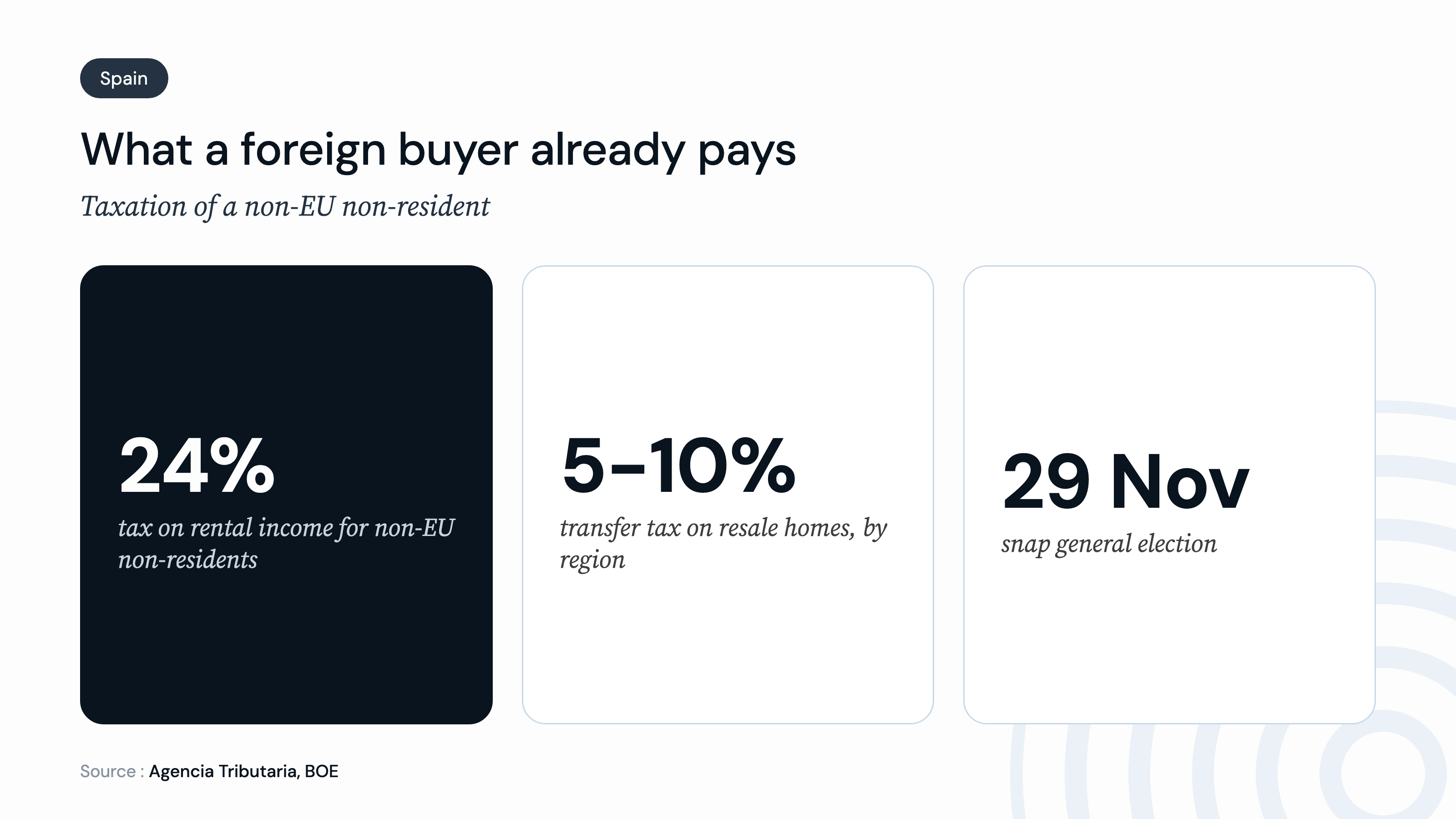
On purchase, a resale home is subject to transfer tax of 5 to 10% depending on the region. A new-build home carries 10% VAT plus stamp duty of 0.5 to 1.5%. Afterwards, rental income earned by a non-resident is taxed at 19% for EU or EEA residents, but at 24% for everyone else, and in most cases the latter cannot deduct expenses. Even a home that is not rented out is taxed: non-resident owners must declare a notional income every year.
On top of that come growing restrictions on tourist rentals. Regions and big cities, from Barcelona to Málaga and the Balearics, are limiting new licences, and a national register of short-term rentals was introduced in 2025. The model of buying a coastal apartment to let by the week is becoming harder and harder.
What already weighs on a non-EU buyer in Spain.
The 29 November election, and then?
What happens next depends on the ballot box. If the left stays in power, the logic of the last two years should continue: rent controls, restrictions on tourist rentals and perhaps a new version of the foreign-buyer tax, which would have to be refiled. If the right wins, several of these measures could be dropped, but public pressure over housing will not go away. The regions, which control part of property taxation and tourism policy, will keep tightening their own rules.
It is also worth remembering that the 100% tax did not fail only because the opposition was against it. Some of the government's usual partners, such as Junts and Podemos, did not back it either, for opposite reasons. The issue remains popular with voters, and it could return in another form.
For investors, the uncertainty is the problem in itself. Buying property in Spain today means betting on rental and tax rules that can change from one decree to the next, be rejected three days later, and come back after an election.
Our view
Spain illustrates a trend we see in many European countries: housing has become an explosive political issue, and foreign investors are a convenient target. Measures do not always pass, but announcing them is enough to change the picture. An investor who was hesitating in January 2025 had no way of knowing whether or when the tax would be voted: many preferred to wait, or to look elsewhere.
That is why we steer clients towards countries that, on the contrary, want to attract foreign investors and offer them simple rules: full freehold ownership, light and stable taxation, and no discrimination between local and foreign buyers. Georgia is one of them: a foreigner can buy in their own name, without a local partner, on the same terms as a Georgian.
What to watch
The result of the 29 November election and the formation of the new Cortes, scheduled for 23 December. Party platforms on housing and non-resident taxation during the campaign, from 13 to 27 November. Regional decisions on tourist rental licences. And a possible return, in 2027, of a tax on foreign buyers in another form.
Conclusion
The 100% tax on non-EU buyers will not happen, at least not in this parliament. But Spain has abolished its golden visa, made repeated attempts to regulate rentals and put housing at the heart of its election campaign. For Swiss, British or other non-EU investors, the squeeze is tightening even when the measures fail. To discover a country that has made the opposite choice, visit our page on investing in Georgia.
Looking for a country that welcomes foreign investors?
Some markets let foreigners buy on the same terms as locals, with simple and stable rules. If that interests you, let's take 30 minutes to talk. The first conversation comes with no commitment.