UK non-dom abolition: are the wealthy really leaving?
Eighteen months after the reform, modest official figures and worrying signals from the ground: what we know about departures, prime London and where the wealthy are going
by
Adrien Boucher
The UK abolished non-dom status in April 2025. Official figures show a modest fall, but 30% of advisers believe a quarter of former non-doms left within a year. Prime London property is down, the 28 October Budget offered no relief: where things stand and where the wealthy are going.
For more than two centuries, the United Kingdom offered wealthy foreigners a status unlike any other: "non-dom". A UK resident whose domicile of origin was abroad could pay UK tax only on British income and on the money brought into the country. Foreign income and gains, as long as they stayed offshore, were out of reach of the UK taxman. That status did more than anything else to make London, for decades, Europe's capital of private wealth.
The regime ended on 6 April 2025. Eighteen months on, the question divides the country: have the wealthy left? Official figures say "a little". Tax advisers, prime property agents and parts of the press say "a lot". The truth probably lies in between, and it will not be fully known until 2027. But several signals now point in the same direction, and they matter to anyone following wealth taxation in Europe, including the many British families already based in Dubai, Lisbon or Milan.
What changed in April 2025
The reform replaced a domicile-based system with a residence-based one. The remittance basis, which allowed foreign income to remain outside the UK tax net, was abolished.
In its place, new arrivals get full relief on foreign income and gains for their first four years of residence, provided they have not been UK resident in the previous ten years. After that, they are taxed like any other resident, on their worldwide income.
The most feared change concerns inheritance tax. It now applies at 40% to the worldwide estate of anyone who has been UK resident for at least ten of the previous twenty years. Leaving does not end the exposure immediately: it continues for a "tail" of up to ten years after departure, depending on how long the person lived in the UK. Offshore trusts, which used to shelter much of this wealth, have lost most of their advantages.
To ease the transition, the government created a Temporary Repatriation Facility allowing previously untaxed foreign income to be brought in at a reduced rate, 12% for the first two years and then 15%. But for many families the question was no longer what repatriation would cost, but whether to stay at all.
What the official figures say
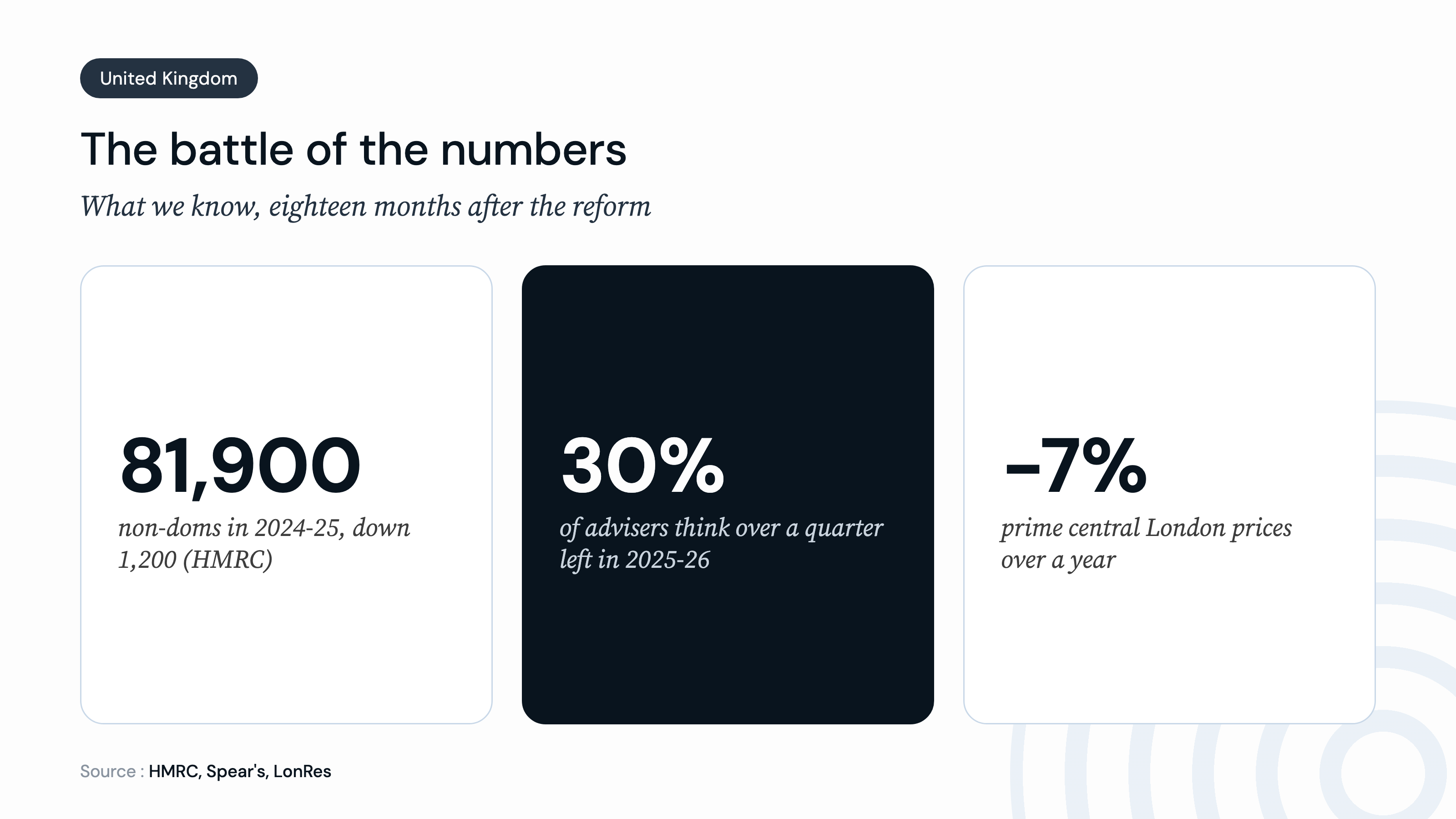
The only official data so far was published by HMRC at the end of July 2026. It covers the 2024-25 tax year, the last under the old regime. The number of non-dom and deemed-domiciled taxpayers fell from 83,100 to 81,900, a drop of around 1,200. About 9,000 left the status, against 11,200 the year before, while new arrivals fell from 10,000 to about 8,600. Their combined tax and National Insurance liabilities actually rose 9% to £13.6 billion.
Supporters of the reform seized on these numbers. The Tax Justice Network described an exodus that "did not occur", and the Financial Times said the data cast doubt on claims of mass flight. The government itself acknowledges it will only be able to publish reliable estimates of post-reform departures in 2027, once returns for 2025-26 have been processed.
That is the key point: the official figures cover the year before the reform. They measure departures in anticipation, not the effect of the reform itself.
The numbers behind the debate, autumn 2026.
What the professionals say
On the ground, the story is very different. According to a survey published in October by Spear's among tax advisers to high-net-worth clients, 30% believe more than a quarter of former non-doms left the UK in the 2025-26 tax year alone. That is precisely the threshold beyond which, according to the CEBR consultancy, the reform would cost more than it raises.
Private estimates point the same way. Former Treasury economist Chris Walker estimated in autumn 2025 that at least 1,800 non-doms had already left, 50% more than expected, accusing the Treasury of "flying blind". Research by Rathbones suggests almost 6,000 entrepreneurs left between 2024 and 2026. And a Telegraph calculation, picked up by the international press at the end of October, put the wealth of billionaires who have left since Labour took office at more than £120 billion.
These figures need care: many come from sources with a stake in the debate, and their methods are contested. But they describe a trend borne out by well-known names. Steel magnate Lakshmi Mittal moved his tax residence to Switzerland. Hedge fund manager Chris Rokos settled in Greece. Other figures from the City chose Milan.
Diversify beyond Europe
Simple, stable rules for your wealth: let's talk in 30 minutes.
The market that reacts fastest is prime central London. According to LonRes, transactions in the top end of the market fell by more than 32% over twelve months, and prices by 7%. In Mayfair, Knightsbridge and Belgravia, agents describe a market where international buyers are scarce and sellers more numerous.
The market has not collapsed. Sales above £15 million actually rose in the first half, with 34 deals worth £1.24 billion, according to Beauchamp Estates. But the underlying trend is clear: London is no longer the obvious destination for international wealth that it was even five years ago.
The Thames and the City. London remains a financial capital, but it is no longer the default home for global wealth. Photo: Donnchadh H, CC BY 2.0, Wikimedia Commons
An Autumn Budget that offers no reassurance
The Budget delivered on 28 October by Chancellor John Healey did not reverse the trend. It neither restored a regime for non-doms nor softened inheritance tax. Instead, it raised tax on savings and property income, with rates rising to 24%, 44% and 49% depending on the band from April 2027, as we covered in our article on the UK Autumn Budget.
Meanwhile, measures already legislated take effect next spring: most unused pension funds will fall within inheritance tax from 6 April 2027, and income tax thresholds stay frozen until 2031. In early November, the head of the Office for Budget Responsibility told MPs that these stealth taxes were weighing on living standards.
For a wealthy family still hesitating, the message is clear: the direction will not change any time soon.
Where are they going?
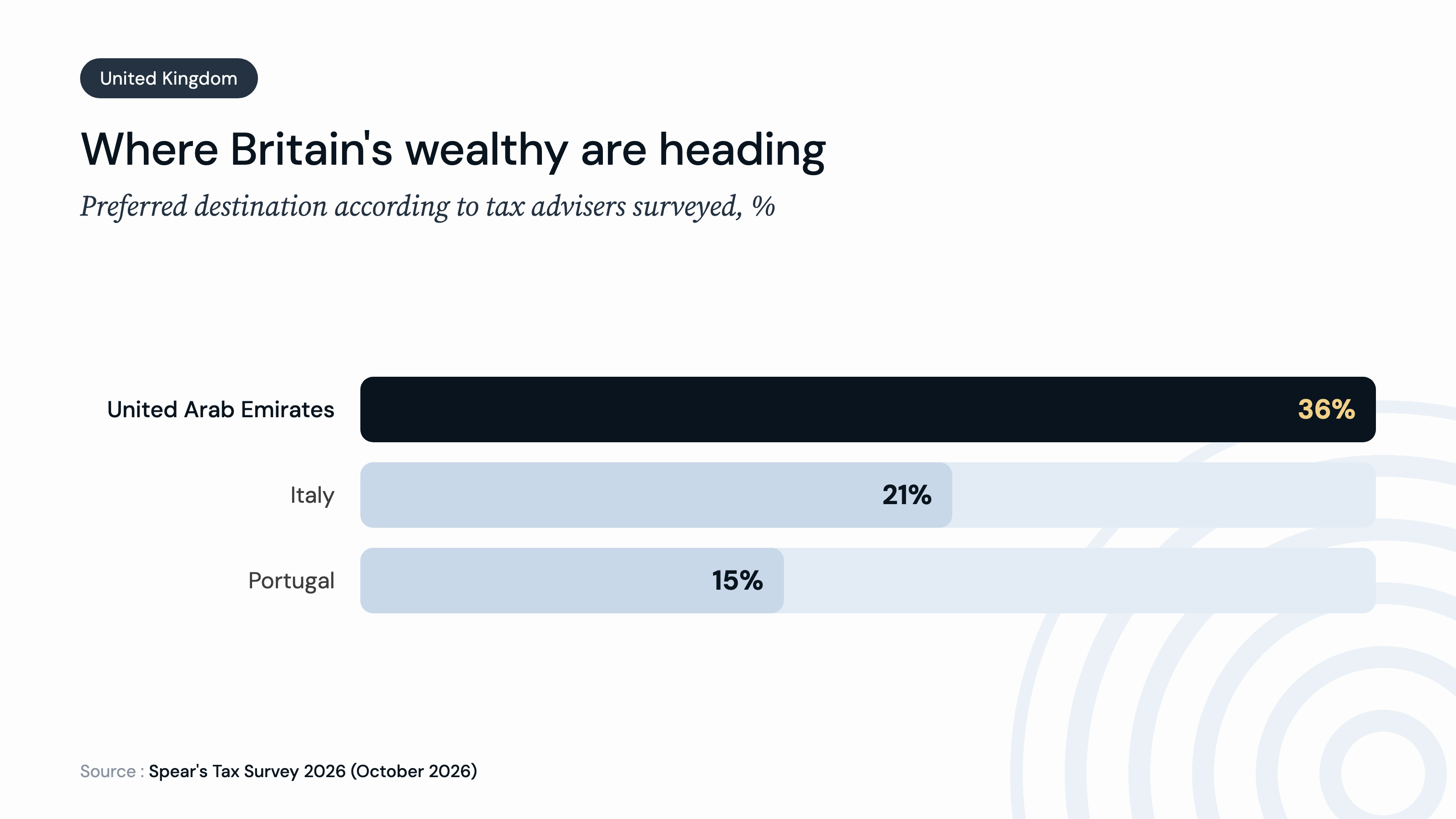
The Spear's survey gives a sense of preferred destinations. The United Arab Emirates comes first, cited by 36% of advisers, followed by Italy at 21% and Portugal at 15%. For entrepreneurs, the preference for the UAE is especially strong, thanks to the absence of personal income tax and a simple framework.
Italy attracts with its flat tax for new residents, a fixed annual charge on all foreign income. It started at €100,000 in 2017, doubled to €200,000 in 2024 and has been €300,000 since January 2026. It remains attractive for the very wealthy, but it also shows how European incentives tend to tighten over time, as we saw with the gradual closure of Europe's golden visas.
Preferred destinations for wealth leaving the UK, according to tax advisers.
Our view
The story of the UK non-dom regime illustrates something we see across Europe. Tax regimes that favour mobile wealth are being dismantled one after another, in the name of fairness or public finances. The UK abolished non-dom, Italy has tripled its flat tax, the Netherlands is raising tax on savings, and Hungary and the European Parliament are debating wealth taxes, as we described in our article on the return of wealth taxes in Europe.
The lesson for investors, billionaires or not, is twofold. First, a tax advantage granted by a state can be withdrawn, sometimes after decades. Second, those who planned ahead had choices, while those who waited until the last moment remain exposed for years, as the ten-year inheritance tax tail shows.
That is why we advise clients not to make their wealth depend on a single country and a single tax regime, and to build part of their assets outside the European Union and the UK, in jurisdictions with simple and stable rules.
What to watch
HMRC statistics for 2025-26, due in 2027, which will finally show how many non-doms left after the reform. The Finance Bill implementing the 28 October Budget, and inheritance tax on pensions from 6 April 2027. Prime London property prices. And how other European countries respond: some may follow the UK, others may try to attract the wealth that is leaving.
Conclusion
Eighteen months after the end of non-dom, the UK has not seen the instant exodus some predicted, but it has not kept everyone who could leave either. Official figures remain modest, signals from the ground are more worrying, and the full picture will emerge in 2027. One thing is certain: a country that built its appeal on a tax regime for two centuries can lose it in a matter of months. For any family's wealth, diversification remains the best protection. To explore one option, visit our page on investing in Georgia.
Looking to diversify beyond Europe?
Some jurisdictions offer simpler, more stable rules for building part of your wealth. If that interests you, let's take 30 minutes to talk. The first conversation comes with no commitment.