Wealth tax: Hungary, the Netherlands and the European Parliament put private wealth back in the spotlight
A 1% tax on large fortunes in Hungary, actual gains taxed in the Netherlands, a minimum tax debated in Brussels: the trend is confirmed
by
Adrien Boucher
Hungary plans to tax fortunes above USD 3 million from 2027, the Netherlands is reforming how savings are taxed and the European Parliament is debating a 2% minimum tax on very large fortunes. What this convergence means for investors.
For years, the wealth tax seemed to be on its way out in Europe. In the 1990s, around a dozen OECD countries levied one. Most have since abolished it: Austria, Denmark, Germany, Finland, Sweden and, in 2018, France, which replaced its general wealth tax with a tax on real estate wealth only. Today, only three European countries still levy a wealth tax in the strict sense: Spain, Norway and Switzerland.
But in just a few weeks, autumn 2026 has shown the topic coming back through several doors at once: in Hungary, in the Netherlands and at the European Parliament. None of these measures is final yet. Taken together, however, they point in one clear direction: wealth taxation is tightening across the European Union.
We follow this closely because it directly affects our clients. Many of them, whether based in Belgium, Switzerland, the Gulf or elsewhere, have built their wealth in Europe, often across several countries, on the assumption that a good geographic spread was enough to protect it. What is happening this autumn suggests that may no longer be the case.
Hungary to tax the largest fortunes from 2027
On 6 October, Hungarian Prime Minister Péter Magyar announced a wealth tax starting on 1 January 2027. The rate would be 1% a year on wealth above one billion forints, around USD 3 million, and 1.5% above 100 billion forints.
The tax would cover all forms of wealth: property, investments, company holdings and even assets held abroad. The first payment would be due in August 2027, based on wealth held at the end of 2026. Debts would be deductible, and only people whose wealth reaches the threshold would have to file a return. According to the Prime Minister, between 15,000 and 25,000 people would be affected. The government, which initially spoke of 300 to 600 billion forints a year, now expects around 200 billion in the first year, just over USD 600 million. Parliament, where the governing party has a large majority, still has to approve the bill.
Several questions remain open, and they are not minor. The trickiest is valuation: what is a stake in an unlisted company, a collection or a plot of land worth? Many European wealth taxes have stumbled on exactly this. For taxpayers, it means years of disputes with the tax authorities over the value of their assets.
The signal is all the stronger because Hungary long presented itself as one of the EU's lowest-tax countries, with a 9% corporate tax rate, the lowest in Europe. A change of government was enough to make wealth a target. That is precisely the point we make to our clients: in Europe, a tax advantage is never permanent.
The Netherlands moves to tax actual gains
In the Netherlands, the government presented a reform of "Box 3", the regime that taxes private savings and investments, at the end of September. The tax is currently based on a deemed return, at a 36% rate. From 2028, it would apply to actual gains for most assets, and to all assets from 2030.
The government has promised to spare smaller savers. But for investors, the logic remains one of heavy taxation of financial wealth, in a country often seen as capital-friendly. At 36%, a Dutch investor realising a EUR 100,000 gain would hand more than a third of it to the state.
The Binnenhof in The Hague. The Netherlands is reforming how savings and investments are taxed. Photo: Hubertl, CC BY-SA 4.0, Wikimedia Commons
The European Parliament opens the debate
In Brussels, the European Parliament's tax subcommittee held a hearing on taxing large fortunes on 12 October. The EU Tax Observatory argued for a 2% minimum tax on fortunes above EUR 100 million, with no exemptions by asset type. By its own estimates, such a tax could raise around EUR 67 billion a year across the EU, and EUR 121 billion at a 3% rate. Figures like these explain governments' interest, at a time when European budgets must fund debt, defence and the energy transition all at once.
The hearing creates no obligation. It will feed into an own-initiative report the Parliament is preparing. Several MEPs warned about the impact of such a tax on competitiveness and on the departure of wealthy taxpayers. But the very fact that the topic is now debated at EU level is a signal in itself. A few years ago, it would have been unthinkable.
Diversify beyond the EU
Lighter taxation, more stable rules: let's talk about your wealth strategy in 30 minutes.
The two European countries that kept a genuine wealth tax offer a preview of what may await the others.
In Spain, the wealth tax is set by the regions, and some, such as Madrid, had effectively abolished it. In 2023, the central government introduced a solidarity tax on large fortunes, applying above EUR 3 million and designed to offset regional exemptions. Taxpayers who thought they were sheltered were caught by a single budget law.
The first-year figures are telling. Around 12,000 taxpayers paid the tax, 0.1% of Spanish filers, with an average bill of about EUR 52,000. It raised EUR 623 million, of which EUR 555 million came from the Madrid region alone, the very region that had abolished its own wealth tax. The government had hoped for up to EUR 1.5 billion. Presented as temporary for 2023 and 2024, it was subsequently extended. That is often how it goes: a "temporary" tax tends to stay.
In Norway, the government raised the wealth tax rate on the largest fortunes in 2022. In the months that followed, several dozen wealthy individuals left the country, most of them for Switzerland, taking part of the expected revenue with them. According to Norwegian Finance Ministry data, 82 wealthy taxpayers, with combined net wealth of around NOK 46 billion, left the country in 2022 and 2023. More than 70 of them settled in Switzerland, according to the business daily Dagens Næringsliv. They included some of the country's best-known entrepreneurs.
The debate remains heated in Norway: supporters of the tax point out that its revenue has kept rising, to around 0.6% of GDP. But Norway has become a textbook case: a wealth tax that is too heavy often ends up driving away the very people it targets, and with them their companies, their investments and their future taxes.
Switzerland, the exception that proves the rule
Switzerland has long levied a wealth tax at cantonal level, with rates generally between a few tenths of a percent and just under 1%. But it made a very different choice when a new tightening was put to the vote. On 30 November 2025, Swiss voters rejected by 78.3% an initiative proposing a 50% tax on inheritances above CHF 50 million.
That is the key difference between Switzerland and the European Union: in Switzerland, citizens have the final say, and they favour stability. It is also why Switzerland has welcomed so many Norwegian fortunes.
Why a 1% tax weighs so heavily
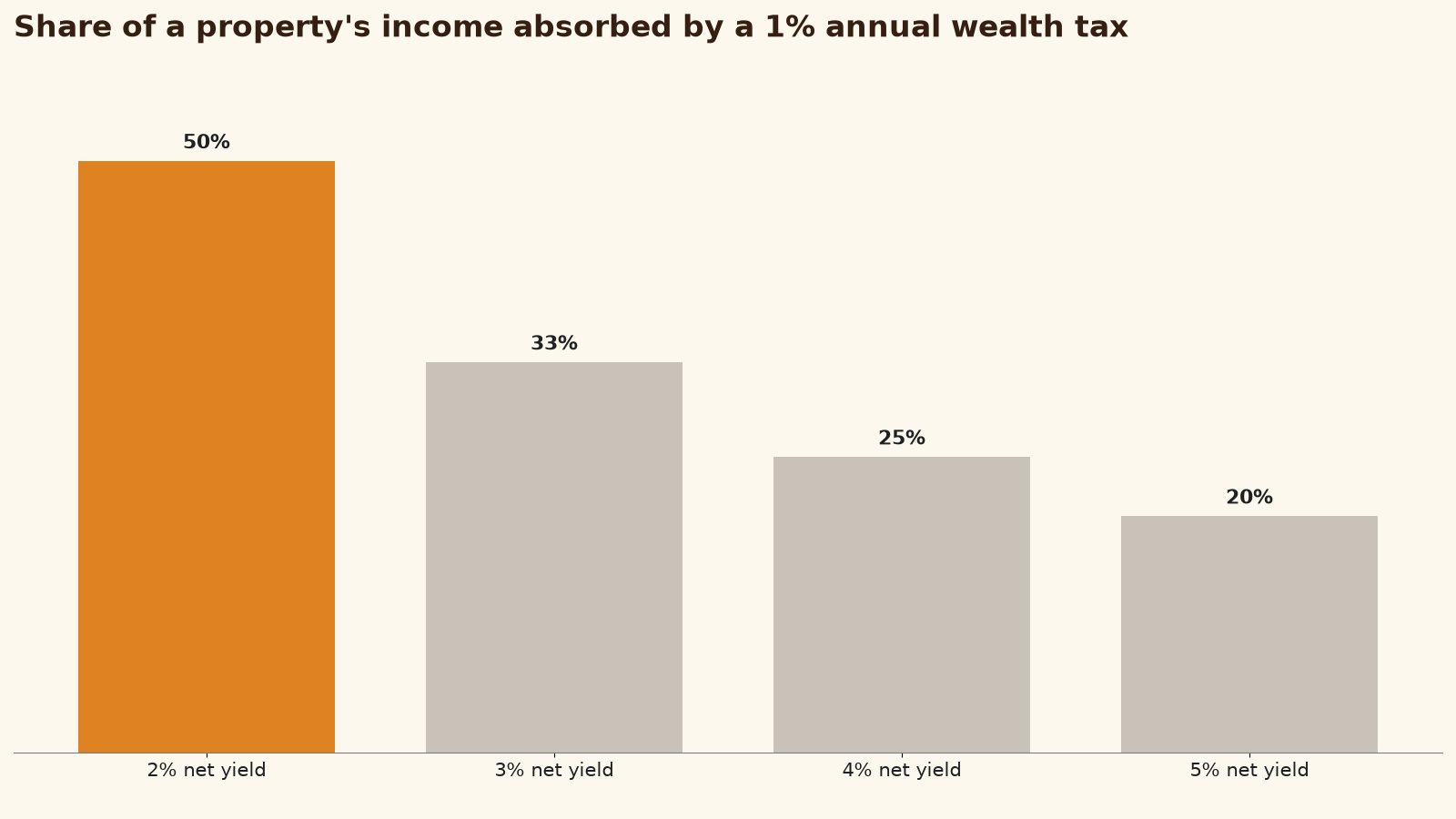
A 1% rate may sound modest. It is not, because it applies to the value of the assets, not to the income they produce.
Take a property yielding 2% net a year, typical of an apartment in a major European city such as Paris, Amsterdam or Munich. A 1% tax on its value absorbs half of that income. For a property yielding 4% net, it absorbs a quarter. The lower the yield, the more confiscatory a wealth tax becomes.
A 1% tax on an asset's value absorbs half the income of an investment yielding 2% net, and a fifth of one yielding 5% net.
That is the core problem for European wealth today: low returns, and taxation that increasingly targets capital itself.
Not just a continental story
The same pressure is visible elsewhere. In the UK, the latest Autumn Budget raised tax rates on savings and property income. In France, the 2027 budget debate has revived proposals targeting large fortunes and inheritance, even if the minimum tax on the very wealthy was rejected again in October. Across Europe, governments facing high debt are looking at private wealth as a source of revenue.
Our view
What stands out is not any single measure. It is the convergence. Governments of very different political stripes, in Central and Western Europe, are looking to wealth for new revenue. And once the topic reaches the European Parliament, it becomes hard to see any EU country as permanently sheltered.
The reason is well known: European states are indebted, their spending is rising, and household wealth is a visible resource, hard to move when it is held in property. It is also why several countries have closed their golden visa programmes in recent years: Europe is no longer trying to attract capital, it is trying to tax it.
For investors, the conclusion is simple. Spreading wealth across several EU countries may no longer be enough to protect it from tax tightening. Real diversification also means jurisdictions outside the EU, with lighter and more stable rules.
Our advice
We do not advise our clients to sell everything or move everything. We advise them not to keep all their wealth in one place, under one set of rules.
In Georgia, for example, there is no wealth tax. Rental income is taxed at a flat 5% and capital gains are tax-free after two years of ownership. And returns are of a different order: in Batumi, we see net rental yields of 8 to 12%, with prices rising by 15 to 20% a year. Find out more on our page about investing in Georgia.
In the United Arab Emirates, there is neither personal income tax nor wealth tax. Both countries offer what Europe offers less and less: visibility.
What to watch
The Hungarian Parliament's vote on the wealth tax, final adoption of the Dutch reform, and publication of the European Parliament's own-initiative report.
Conclusion
The wealth tax has not disappeared from Europe. It is changing its form, its name and its country, but the direction is the same: private wealth is being asked to contribute more. Spain and Norway show how far it can go; Hungary and the Netherlands show that no country is sheltered any more. For long-term investors, that is one more reason to look beyond the EU's borders.
Looking to diversify beyond the EU?
Lighter taxation, more stable rules: serious alternatives exist. If you would like to explore them, let's talk for 30 minutes. The first conversation comes with no commitment.