Why more and more Swiss investors are investing abroad, and in Batumi
Zero interest rates, very expensive Swiss property, yields below 3%, the end of the imputed rental value: what is pushing Swiss investors to look elsewhere
by
Eric Fankhauser
In Switzerland, the policy rate is at 0%, gross rental yields stay below 3% and Zurich tops the global housing bubble risk ranking. With the imputed rental value ending in 2029, more Swiss investors are looking abroad, including to Batumi.
A lot is said about investors from high-tax countries moving money abroad. Less is said about the Swiss. Yet in recent years, we have seen more and more Swiss investors take an interest in markets like Georgia, and in Batumi in particular.
Their reasons are not quite the same. In Switzerland, the tax burden remains moderate and the rules rarely change. What pushes the Swiss to look elsewhere is mainly a question of returns, prices and diversification. The trend is quieter than elsewhere in Europe, but it is very real.
I see it first-hand. I have worked with investors in French-speaking Switzerland for several years, and we regularly hold events there, such as our evening at F Motors in Chavannes-de-Bogis. Each time, the same questions come up: why does my money earn nothing in Switzerland any more, and where can I find a serious return without taking reckless risks?
Savings that barely earn anything
First observation: in Switzerland, risk-free money barely earns anything anymore. The Swiss National Bank has kept its policy rate at 0% since 2025, and its own forecasts assume it will remain unchanged until 2028. It is the lowest policy rate among major central banks.
For savers, that means savings accounts and conservative investments that barely cover inflation. Inflation is admittedly very low, with around 0.6% expected in 2026, and the SNB expects it to stay below 1% until mid-2028. But an investment yielding 0.5% while prices rise 0.6% is simply losing value slowly. Swiss government bonds yield very little, and cantonal banks offer token rates on savings accounts. Even the second pillar, occupational pensions, now credits only modest interest on members' savings.
And for many, the question becomes: where can my money really work? Equities are one answer, but their volatility does not suit everyone. For most Swiss investors, property remains the safe haven of choice.
The Swiss National Bank in Bern. Its policy rate is at 0% and is expected to stay there until 2028. Photo: Blankenstijn Andrea, CC BY-SA 3.0, Wikimedia Commons
Investing abroad from Switzerland
Yield, tax, the double taxation agreement: let's talk about your situation in 30 minutes.
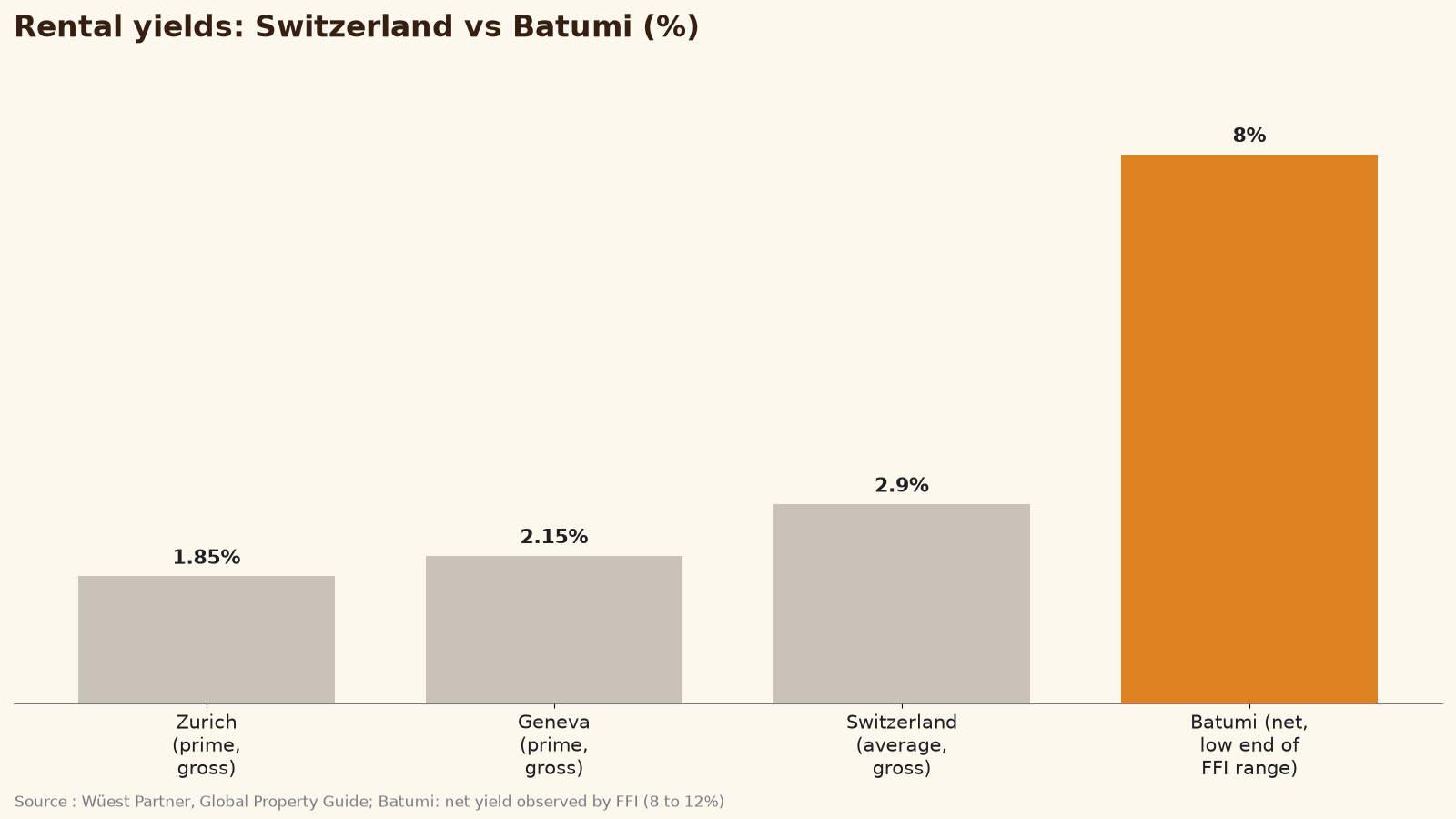
The traditional answer is property. But Swiss real estate has become very expensive. According to Global Property Guide, the average gross rental yield on Swiss residential property is around 2.9%, and remains below 3% in Zurich, Geneva, Bern and the canton of Vaud. For prime properties, Wüest Partner estimated yields at around 1.85% in Zurich and 2.15% in Geneva in the first quarter of 2026.
And prices remain under scrutiny. In September, UBS published its Global Real Estate Bubble Index: Zurich ranks first among the cities where the risk is judged highest worldwide, ahead of Tokyo and Miami, with Geneva in sixth place. The bank attributes the pressure to very low financing costs. When money costs almost nothing, buyers can pay more, and prices rise faster than rents. That is exactly what drives yields down.
The figures confirm it. In early 2026, a ten-year fixed Swiss mortgage cost roughly 1.5 to 2%, and mortgages linked to SARON, the Swiss money-market reference rate, around 1%. With financing this cheap, house prices keep climbing: according to the Wüest Partner index published by the SNB, transaction prices rose by almost 4.5% year on year in the first quarter of 2026, and the main institutes still expect a further 3 to 4% this year. Rents are not keeping pace.
For investors, the result is mechanical: paying more and more for income that barely grows. And the risk of a correction rises with the price level. UBS still sees that risk as moderate nationally, but considerably higher in the two big cities.
In practical terms, for CHF 100,000 invested in an apartment in Zurich or Geneva, an owner receives less than CHF 3,000 a year in gross rent, before service charges, maintenance and tax. Once everything is deducted, often less than CHF 2,000 is left.
In Switzerland, gross rental yields stay below 3%. In Batumi, we see net yields of 8 to 12%.
The end of the imputed rental value
Another change will weigh on owners. On 28 September 2025, Swiss voters approved, by 57.7%, the abolition of the imputed rental value, the tax on the notional rent of owner-occupiers. In return, cantons will be able to introduce a special tax on second homes used by their owners. The Federal Council has set its entry into force for 1 January 2029.
Good news for many owner-occupiers, but with a trade-off: mortgage interest and part of maintenance costs will no longer be deductible as before. For some, this is a reason to reduce their Swiss mortgage debt and rethink how their wealth is allocated.
Take an owner with an apartment in Lausanne and a CHF 600,000 mortgage. Until now, they declared an imputed rental value but deducted mortgage interest and maintenance costs. From 2029, they will no longer pay tax on the imputed rent, but they will no longer be able to deduct the interest either. Carrying a large mortgage therefore loses much of its tax appeal. Many owners are considering paying down part of their loan or reallocating their savings. That is often when the question of investing abroad comes up.
Owners of second homes will need to watch what their canton decides. For a chalet in Valais or a holiday flat in Graubünden, the end of the imputed rental value could be offset by a new cantonal tax, again reducing the net return on Swiss property.
Why Batumi appeals to Swiss investors
Against this backdrop, markets like Georgia stand out. In Batumi, we see net rental yields of 8 to 12% and prices rising by 15 to 20% a year, with entry tickets from EUR 40,000. The gap with Switzerland is considerable.
Other factors reassure Swiss investors. Foreigners can buy outright, in their own name, without a local partner. Rental income is taxed at 5% in Georgia and capital gains are tax-free after two years of ownership. Switzerland and Georgia signed a double taxation agreement on 16 June 2010, in force since 2011. It covers taxes on income and on capital and follows the OECD model. As a general rule, income from property located abroad is not taxed a second time in Switzerland, but it is taken into account to determine the tax rate. This should be checked with a tax adviser depending on the canton.
Finally, many Swiss investors value the diversification logic: holding part of their wealth in a fast-growing economy that is different from their own, rather than concentrating everything in an already highly valued Swiss market. Georgia is growing by more than 7% a year, has record foreign exchange reserves and public debt of 31.6% of GDP, and its National Bank expects the lari to remain strong until 2029, as we explained in our article on Georgia's record reserves.
Closer than you might think
For many Swiss, Georgia still feels distant and little known. Less and less so. Tbilisi and Batumi are connected to many European cities by direct or one-stop flights, and Swiss nationals can stay in Georgia visa-free for up to a year. Our clients are often surprised on their first trip: modern cities, renowned cuisine, welcoming people, and mountains a few hours from the sea.
Switzerland is also an outward-looking country. More than 800,000 Swiss citizens live abroad, more than one in ten. Investing beyond its borders is nothing exotic for a Swiss saver: it is a natural extension of the culture of diversification that has long underpinned the reputation of the Swiss financial centre.
A concrete example
Take a Geneva-based investor with CHF 150,000. In Geneva, that amount would not even cover the deposit on an average apartment, and it would yield less than 3% gross. In Batumi, the same sum buys a well-located apartment a few minutes from the sea, in a quality residential building.
With a net yield of 8 to 12%, that property earns between CHF 12,000 and CHF 18,000 a year after costs and management. If they wish, the investor can also finance part of the purchase locally: mortgage lending in Georgia is open to foreigners, and we obtain rates of 7 to 8% for our clients.
One point deserves honesty: a Swiss investor buying in Batumi takes on dollar exposure, since prices there are generally set in US dollars. The franc is a strong currency, and that has to be factored in. But with net yields of 8 to 12% and prices rising by 15 to 20% a year, the gap with Switzerland leaves a comfortable margin.
Batumi, on the Black Sea. Net yields of 8 to 12% and prices rising 15 to 20% a year. Photo: Dmitry A. Mottl, CC BY-SA 4.0, Wikimedia Commons
What I see on the ground
The Swiss investors I work with often share a clear profile. They are cautious, they ask a lot of questions, they want to understand the legal structure and visit before committing. And that is exactly right. They are not looking for a speculative bet, but for additional yield and diversification, in a market they have taken the time to understand.
Many travel to Batumi before buying. They want to see the building site, meet the developer, walk to the beach and understand the neighbourhood. We accompany them on the ground, and the decision is often made during that trip. For a first investment, I recommend a central property in a residential building with professional management: the combination that rents best all year round. Our complete guide to investing in Batumi sets out every step.
The questions I am asked most
How do I declare the property in Switzerland? It appears in the tax return as foreign assets and income, used to determine the applicable rate, and in principle is not taxed a second time. What if I want to sell? After two years of ownership, capital gains are tax-free in Georgia, and we handle the resale. Who looks after the property day to day? A professional management company that we select and monitor. And what if the developer does not deliver? That is why we only work with established developers, whose projects are often financed by the country's major banks.
These are good questions, and a Swiss investor is right to ask them before committing.
Conclusion
Zero interest rates, very expensive Swiss property, yields below 3%, the end of the imputed rental value: Swiss investors have plenty of reasons to look beyond their borders. The trend is discreet, but it is taking hold. And Georgia is one of the destinations that best matches what they are looking for. To find out more, visit our page on investing in Georgia.
Based in Switzerland and considering investing abroad?
Yield, tax, the double taxation agreement, legal structure: every situation is different. Let's talk for 30 minutes. The first conversation comes with no commitment.