Georgia: the National Bank expects a strong lari until 2029, and what it means for investors
Record reserves, rising exports and tourism: Georgia's currency is expected to stay solid, under certain conditions
by
Adrien Boucher
In its latest monetary policy report, the National Bank of Georgia forecasts a strong lari over 2027-2029, supported by record reserves, rising exports and tourism. The conditions behind the scenario, and what it means for foreign investors.
In its latest monetary policy report, published at the end of October, the National Bank of Georgia forecasts that the lari will remain strong over 2027-2029. According to the central bank, an improving external balance, driven by exports, tourism and foreign currency inflows, will support the national currency over the next three years.
For an emerging market, this kind of forecast is far from trivial. Many currencies in the region have suffered sharp depreciations in recent years, some losing a large share of their value within months. Georgia, by contrast, has a stable lari today: around 2.60 lari to the US dollar and 2.91 lari to the euro at official end-October rates.
It is a question our clients ask in almost every first meeting, whether they are based in Dubai, Geneva, Brussels or London. An investor buying an apartment in Batumi or Tbilisi wants to know what happens to their money if the local currency falls. The National Bank's forecast provides part of the answer, and it is worth looking at closely.
The lari has weathered storms before
The lari was introduced in 1995, a few years after independence, to replace a transitional currency that had lost almost all its value. Since then, Georgia has opted for a floating exchange rate: the National Bank does not fix the lari's value, it lets the market set it and only intervenes to smooth out excessive swings.
That choice has a cost: the currency has been through difficult periods. In 2014 and 2015, the collapse of the Russian rouble and lower remittances pushed the lari from around 1.75 to more than 2.40 to the dollar. In 2020, the pandemic and the sudden halt in tourism weakened it further, beyond 3.30 to the dollar at the height of the crisis.
But it also has a benefit: a floating currency absorbs shocks instead of storing them up. Each time, the lari recovered as the economy bounced back. Since 2022, with the arrival of many foreign residents, the return of tourism and rising exports, it has strengthened markedly, back to around 2.60 to 2.70 to the dollar, and has held there since.
It is this restored stability that the National Bank now expects to last.
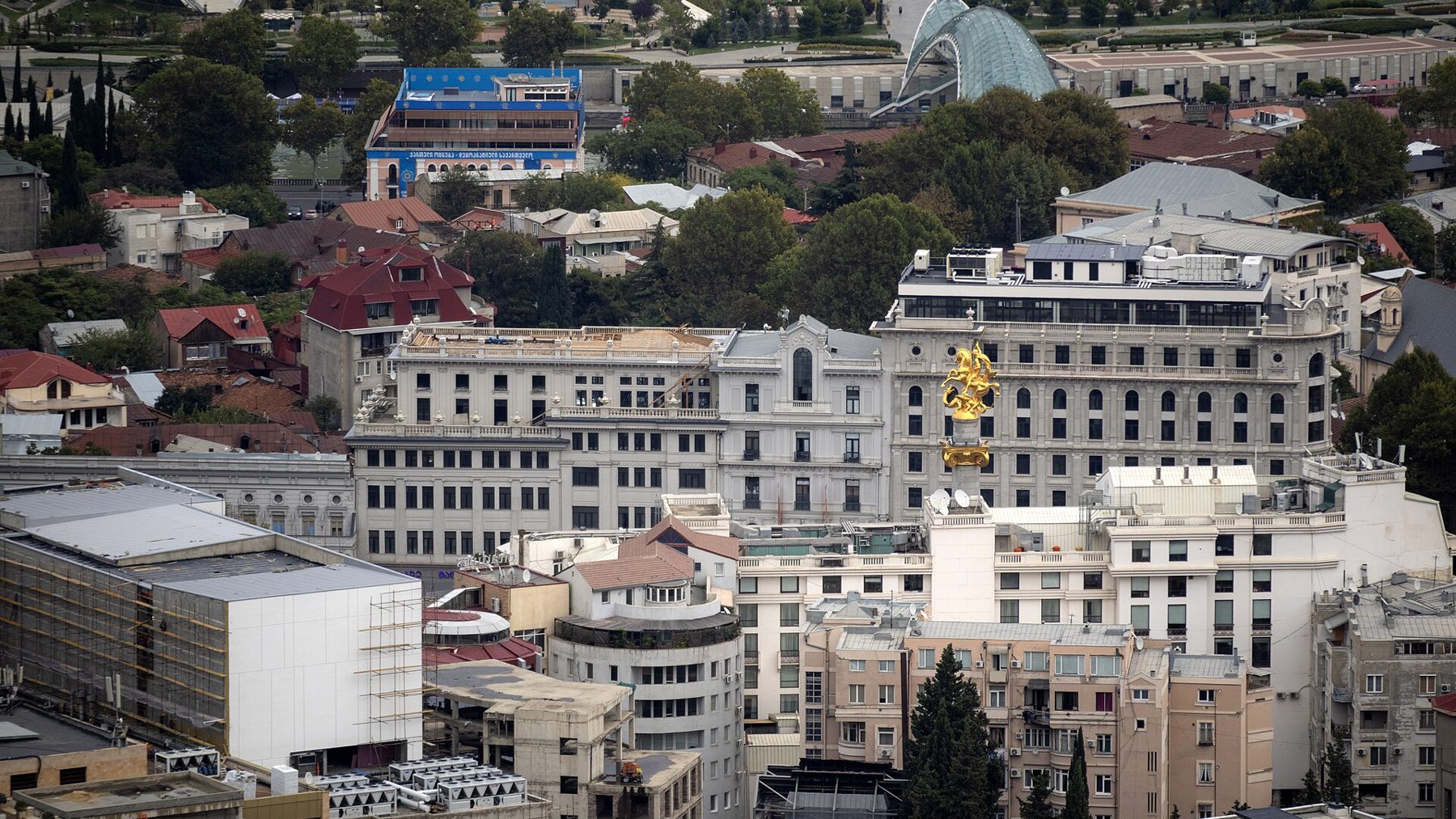
Freedom Square, in the heart of Tbilisi. A stable lari supports the confidence of Georgians and foreign investors alike. Photo: Mostafameraji, CC BY-SA 3.0, Wikimedia Commons
Why the National Bank is confident
Several factors support the forecast. Georgia's foreign exchange reserves reached a record of more than USD 8 billion at the end of September, up more than 50% in a year. We looked at the reasons in our article on Georgia's record reserves and surging exports.
Exports are up almost 20% over nine months. International tourism revenue reached USD 3.8 billion between January and September. And tax revenue, at GEL 17.6 billion over nine months, is 3% above budget targets.
Tourism rebounded strongly this summer. According to the National Bank, revenue from international travellers reached USD 1.86 billion in the third quarter, up 11.9% year on year, after a tougher first half marked by the war in the Middle East and fewer visitors from Iran and Saudi Arabia. Over nine months, it is up 4.4%. The visitor base is also diversifying: arrivals from China rose by almost 24% over the same period.
In other words, the country is bringing in more foreign currency than before, and keeping part of it in reserve to defend its currency in the event of a shock. That is exactly what was missing in 2015, when reserves were much lower and the National Bank had few tools to slow the fall.
Fiscal policy points the same way. The 2027 budget plans public debt of 31.6% of GDP, far below most Western economies, as we explained in our analysis of Georgia's 2027 budget. A government with little debt has no need to print money, which also protects the currency.
Remittances, an underrated pillar
Another driver gets little attention: the money Georgians living abroad send home to their families. More than USD 300 million enters the country this way every month, including USD 340 million in May, USD 321 million in August and USD 318 million in September, with steady year-on-year growth. In the first nine months of 2025, remittances had already exceeded USD 2.6 billion.
Their origin has changed. Ten years ago, Russia was the main source, which made the lari highly sensitive to the Russian economy: that is what weakened it in 2015. Today, the European Union has become the main source of remittances. A more diversified, more stable flow that better protects the currency.
Invest in a stable economy
A solid currency, light taxation, direct ownership: let's talk about your Georgia project in 30 minutes.
The National Bank is not alone in expecting a solid lari. Galt & Taggart, the investment banking arm of the Bank of Georgia group, expects the lari to remain broadly stable, averaging around 2.60 to the dollar in 2027. TBC Capital, TBC Bank's research arm, keeps a neutral view on the exchange rate despite tensions in the Middle East, pointing to strong foreign currency inflows. In October, the lari edged up against the dollar again.
One detail says a lot: in 2025, the National Bank bought around USD 2 billion on the market between March and November, not to support the lari but to stop it appreciating too fast. According to TBC Capital, Georgia even became a net creditor to the rest of the world in 2025. That is the reverse of the situation in 2015.
International institutions share this view. In its latest annual review in June, the IMF raised its 2026 growth forecast from 5.3% to 6.5% and described the Georgian economy as resilient. It expects public debt to fall from 34.3% of GDP in 2025 to 31.7% in 2031. Fitch, which rates Georgia BB, has also raised its growth forecast. And the National Bank has just lifted its own 2026 forecast to 7.2%, from 6.5%, with around 5.5% expected in 2027.
The conditions
The National Bank itself acknowledges that the forecast rests on several assumptions. Tensions in the Middle East need to ease and oil prices to fall from the second quarter of 2027. Foreign currency inflows from tourism, remittances and exports need to stay strong. And no new external shock must disrupt the foreign exchange market.
Some analysts consider the scenario optimistic. It is a forecast, not a guarantee. But it rests on very real fundamentals, and the central bank now has significant means to smooth out fluctuations, which was not the case in previous crises.
A cautious central bank
In the meantime, the National Bank is staying cautious. It held its policy rate at 8.25% on 21 October and expects inflation of 5.4% in 2026, driven mainly by imported energy prices, with core inflation around 3.5%. It expects inflation to return towards its 3% target from the second half of 2027. Since 2009, it has run an inflation-targeting framework, like the European Central Bank or the US Federal Reserve.
It is also working to reduce the role of the dollar in the economy. The share of bank deposits in foreign currency fell to 46.6% in April 2026, down 5.6 points since 2024, and reserve requirements have just been tightened to encourage lending in lari. A less dollarised economy is one where the national currency commands more confidence, from Georgians and foreigners alike.
Finally, the National Bank said in late October that it has no plans for a full-scale digital lari rollout in the coming years. The legal framework now exists, but physical cash remains the rule. One more sign of an institution that prefers caution to headlines.
What it means in practice for an investor
For a foreign investor, currency matters at three points: when buying, while renting and when selling.
When buying, exposure is limited. In the property market, particularly in Batumi, new-build prices are generally quoted and paid in US dollars. An investor buying a USD 120,000 apartment pays USD 120,000, whether the lari is at 2.50 or 2.80.
While renting, the lari matters more. Long-term rents are often set in dollars but paid by tenants who earn in lari. A stable currency preserves their purchasing power, and therefore their ability to pay. In short-term rental, guests are largely foreign and pay in hard currency, so the question matters less.
When selling, it is the health of the local economy and the country's appeal that drive prices. A strong currency, backed by record reserves, reduces the likelihood of a sudden shock that would drive buyers away.
Take an example. An investor buys an apartment in Batumi for USD 120,000. With a net rental yield of 8 to 12%, which is what we see in Batumi, they receive between USD 9,600 and USD 14,400 a year. For an investor whose home currency is the euro, the Swiss franc or the dirham, the real currency question is less the lari than the dollar against their own currency when they bring rent home or sell. Investors based in the Gulf, whose currencies are pegged to the dollar, are naturally protected. For others, it is a point we discuss with every client, and it can be managed: some keep their income in dollars, others convert it regularly.
Our advice
A solid currency is the sign of an economy that inspires confidence. That foundation is what allows the Georgian property market to perform strongly: in Batumi, we see net rental yields of 8 to 12% and prices rising by 15 to 20% a year.
We advise our clients to think in dollars across the whole investment, from purchase to sale, and to treat the lari's stability as an extra layer of security rather than a bet. For those financing part of their purchase locally, mortgage lending in Georgia is open to foreigners, and the currency of the loan is one of the choices we look at with them.
The Kura river in Tbilisi. Foreign currency inflows from tourism, exports and expatriates support the lari. Photo: Mostafameraji, CC BY-SA 3.0, Wikimedia Commons
What to watch
Three indicators will show whether the forecast holds. First, foreign exchange reserves, published monthly by the National Bank: as long as they stay at record levels, the central bank can defend the currency. Second, inflation, which should return towards 3% from the second half of 2027. Third, oil prices, which drive part of the price pressure in Georgia, a country that imports most of its energy.
We follow these figures closely and will report on them here.
Conclusion
Forecasting a strong currency over three years is a vote of confidence few emerging markets can afford. Georgia can, thanks to record reserves, dynamic exports, solid tourism and very low public debt. The lari has weathered storms before and has recovered each time. For investors looking to diversify their wealth across borders, currency stability is a key criterion, and Georgia meets it today. To find out more, visit our page on investing in Georgia.
Want to invest in a stable, growing economy?
A solid currency, light taxation and property ownership open to foreigners: Georgia ticks many boxes. If you are interested, let's take 30 minutes to talk. The first conversation comes with no commitment.