Georgia: European tourists up 20%, their spending up 29%
As Middle Eastern markets retreat, Europe is becoming a pillar of Georgian tourism: what this rebalancing means for Batumi and for investors
by
Leo Lawless
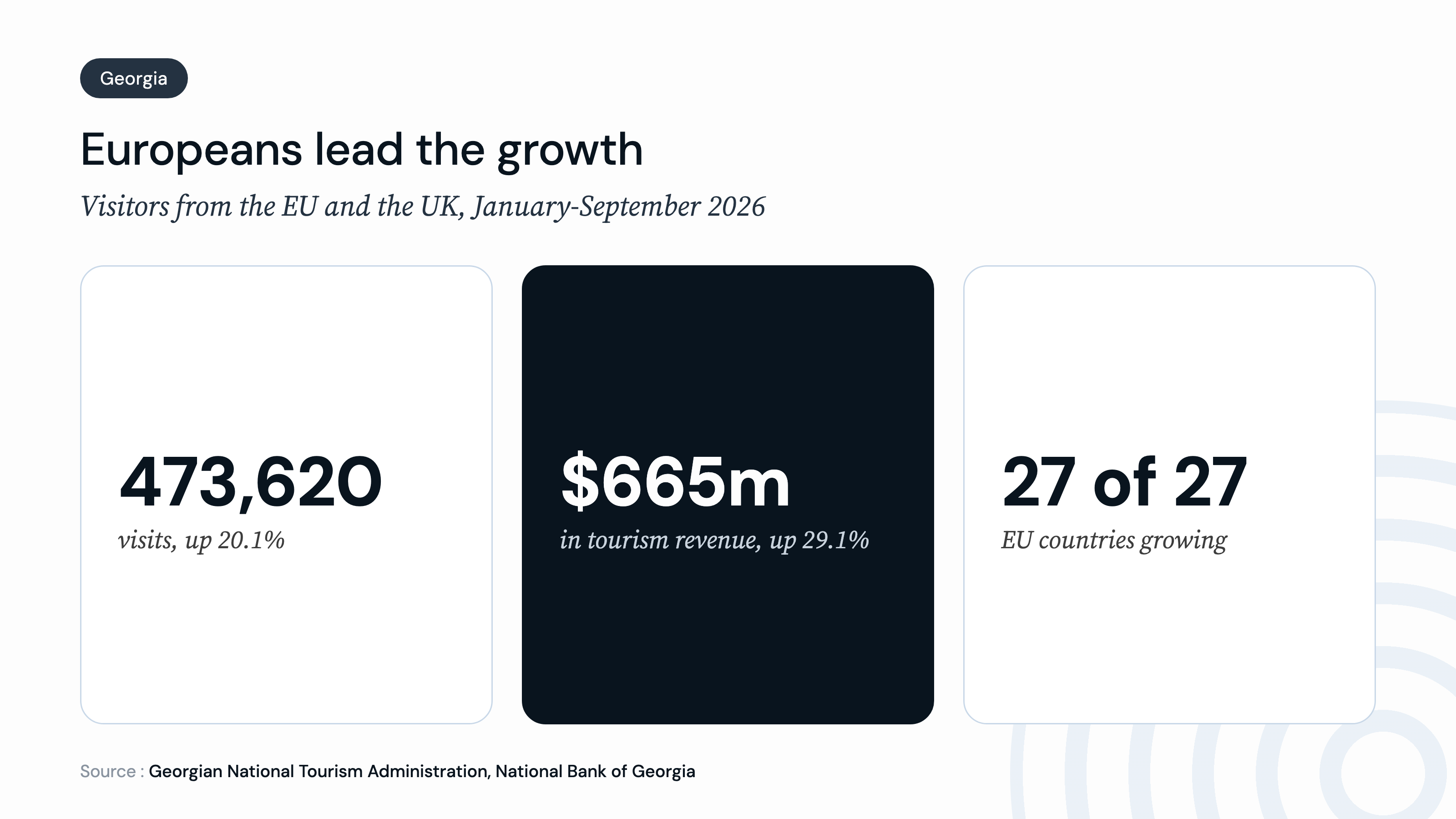
From January to September 2026, visits from the EU and the UK to Georgia rose 20.1% and their spending 29.1%, to USD 665 million. As Middle Eastern markets retreat, Europe is becoming a pillar of Georgian tourism. What it means for Batumi and for property investors.
In the first nine months of 2026, Georgia welcomed 473,620 visitors from the European Union and the United Kingdom, 20.1% more than a year earlier. Their spending grew even faster: USD 665 million in tourism revenue, up 29.1%, according to figures from the Georgian National Tourism Administration and the National Bank of Georgia published at the end of October.
The number means more once you put it in the context of the year. 2026 has not been easy for Georgian tourism. War in the Middle East disrupted air travel and hit several historic source markets, among the highest-spending. In the first half, total international visits fell 3.3% and revenue 2%. European arrivals cushioned the shock, then helped restart growth in the third quarter.
I spend a lot of time in Batumi and Tbilisi with our clients, and I notice it on every trip: more and more German, Dutch, Polish, Italian and French in the streets. It is no longer just an impression. The figures confirm it, and they point to a structural shift for the country.
Growth from every EU country
The rise is broad-based. Over the first nine months, visits grew from all 27 EU member states, without exception. In the first half, visits from Germany were up 21%, France 28% and Poland 10.1%, and European visitor numbers had already hit a record 249,201.
The third quarter extended the trend, with 224,419 European visits, up 16.6%. Some smaller markets surged: Denmark up 56.5%, Lithuania 46.8% and Cyprus 45.2%. Larger markets followed: Italy up 22.7%, the Netherlands 20.1%, the United Kingdom 18.2% and Germany 16.8%.
Growth in European visits in Q3 2026, by country.
The growth rests on the widest flight offer Georgia has ever had. In July, the National Tourism Administration counted a record 85 airlines operating 125 routes from Georgia. The country's airports now connect directly to 42 destinations in the EU and the UK. For Europeans, Georgia has become a direct-flight destination, often at low fares, for a long weekend as well as a longer holiday.
Why spending is growing faster than visits
The most interesting number is not the rise in visitors but the gap between the two curves. When visits grow by 20% and revenue by 29%, each European visitor is spending more than a year earlier.
There are several reasons. Europeans stay longer than visitors from neighbouring countries, who often come for a few days or just for the day. They stay in hotels or rentals, eat out and travel around the country: Tbilisi, Batumi, the Kakheti wine region, the mountains of Kazbegi or Svaneti. Their purchasing power is also higher. It is higher-value tourism.
We should be precise, though. Across all international visitors, average spending fell in the second quarter: according to Georgia's statistics office, it dropped 9.2% to GEL 1,922 per visit, about USD 734, and total visitor spending fell 13.3% in the quarter. That decline mainly reflects the drop in Middle Eastern markets, whose visitors spend heavily. That is exactly what the European boom is offsetting.
European visitors to Georgia, January to September 2026.
Invest in Batumi
Tourism demand is diversifying: let's talk about your project in 30 minutes.
The Middle East retreats, Europe makes up the difference
To understand why this matters, look at what was happening elsewhere. In the first half, visits from Iran fell by 49% after US sanctions targeted several Iranian airlines that served Georgia. Revenue from Saudi Arabia dropped 37% in the first half and a further 31.9% in the third quarter. Israel, one of the highest-spending markets, fell in the first half before rebounding over the summer.
"The Middle East is important not only because of the number of tourists, but because these tend to be high-spending markets," Irina Kvakhadze, senior vice president at TBC Capital, told Investor.ge. Her conclusion: "A diversified market means that if there is a shock in one market, another market can balance it out."
That is precisely what happened. In the third quarter, tourism revenue rose 11.9% to USD 1.9 billion, and overnight tourist visits reached a record 2.13 million, up 4.7%. Over nine months, the country recorded 6.11 million international visits, flat on the year, and USD 3.8 billion in revenue, up 4.4%. After a difficult first half, the year will end in positive territory.
European revenue in the third quarter, USD 310 million, up 30.2%, now makes the EU the country's second-largest source of tourism income, just behind Russia and ahead of Israel and Turkey. A few years ago, Europe was a secondary market. It is becoming a pillar.
What Europeans come looking for
The reasons behind the enthusiasm come down to a few words we hear constantly from clients: something different, easy access and value for money. EU citizens can stay in Georgia for up to a year without a visa, which makes long stays, remote work and frequent trips easy. On the ground, the cost of living remains well below Western Europe's, whether for accommodation, restaurants or transport.
The offer is remarkably varied for a country this size. In a week, a visitor can go from the lanes of Tbilisi's old town to the wine cellars of Kakheti, home to an 8,000-year-old winemaking tradition, then to the peaks of the Greater Caucasus, before ending on the Black Sea coast. That variety draws hikers and food lovers, families and young professionals alike.
Georgia has also gained visibility. Travel guides, social media and word of mouth have made it one of the continent's rising destinations. Many of our clients tell us they discovered the country through a friend or colleague who came back full of enthusiasm.
Batumi on the front line
Batumi benefits directly. In the second quarter, Adjara, the Batumi region, recorded 621,300 visits, just behind Tbilisi with 875,500. The city combines what Europeans are looking for: the sea, a mild climate, nightlife, renowned food and prices that are still accessible, a few hours' flight from major capitals.
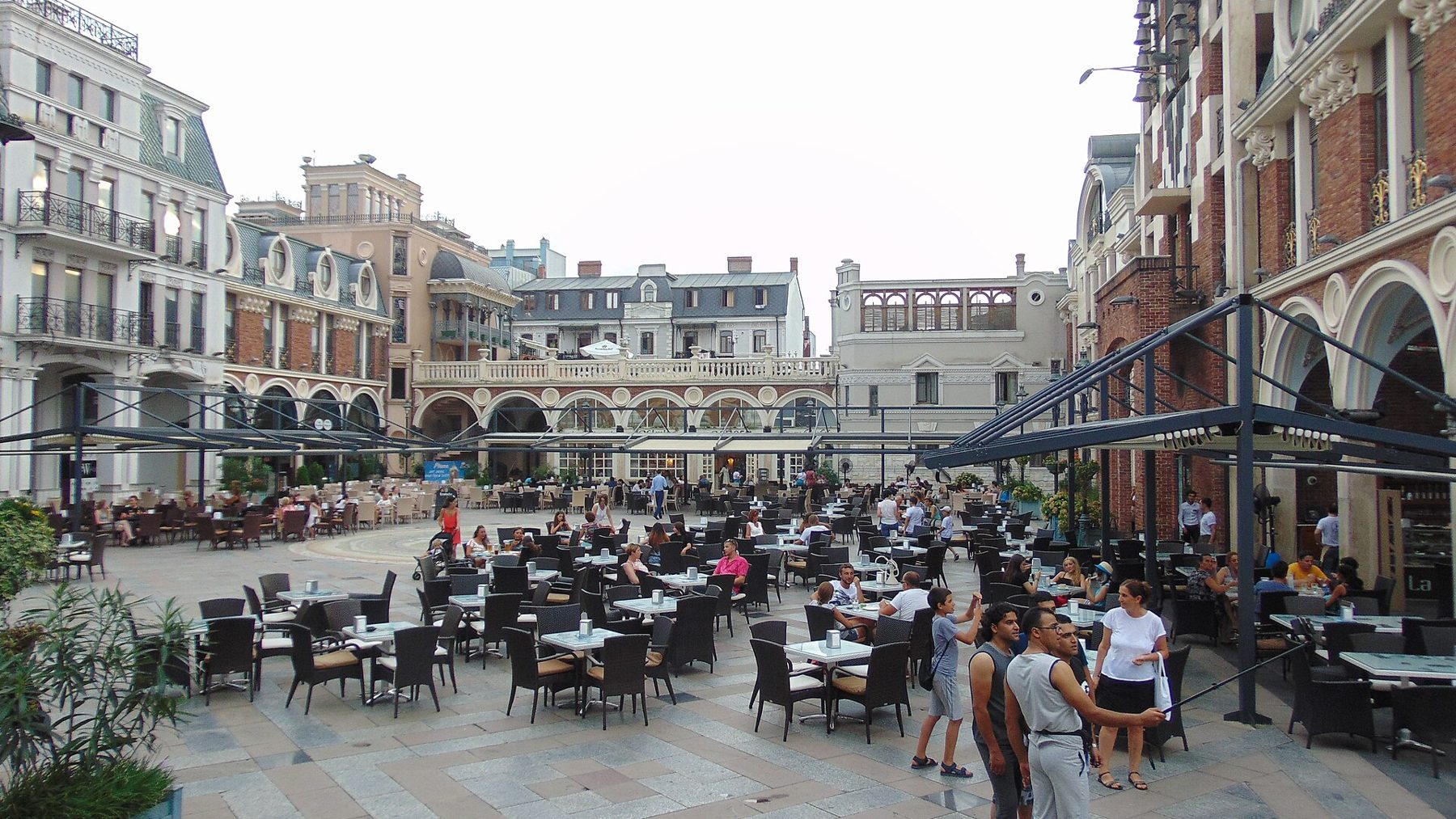
Piazza square in Batumi in high summer. Photo: Kober, CC BY-SA 4.0, Wikimedia Commons
These European visitors are not only passing through. Many come back, some stay for weeks, and some end up settling as expatriates, remote workers or retirees. We wrote about it in on the ground: why we live in Georgia. That is often how an investment project begins: one trip, then another, then the wish for a base that can be rented out when you are not there.
What it means for investors
For a property owner in Batumi, the nationality of visitors is not a detail. European guests book earlier, stay longer, pay higher nightly rates and leave reviews that count on rental platforms. They are also less exposed to the regional shocks that periodically hit the Caucasus and the Middle East.
Above all, a more diverse visitor base makes demand more stable. A city that depends on one or two markets is vulnerable: a crisis, a sanction or an airspace closure can make bookings collapse. A city that attracts Europeans, Russians, Israelis, Turks, Azerbaijanis, Ukrainians and now Chinese visitors, up 30.2% in the third quarter, is far more resilient. 2026 has just proved it.
That is also why we select well-located residences, managed by operators able to let by the night in season and by the month the rest of the year. We explained that approach in our article on managing seasonality in Batumi. In Batumi, we see net rental yields of 8 to 12% and prices rising by 15 to 20% a year.
What to watch
Fourth-quarter figures, which will show whether European momentum holds outside the season. New routes for the 2027 season, particularly from Western Europe. A possible recovery of Middle Eastern markets, which would come on top of European growth. And analysts' forecasts: Galt & Taggart expects slight growth in arrivals in 2026 and around USD 4.9 billion in tourism revenue for the year.
Conclusion
In a year marked by regional tension, Georgia has found a solid growth engine in Europe: 20% more European visitors, 29% more spending and growth from every one of the 27 EU countries. This rebalancing makes Georgian tourism more diverse, more resilient and more lucrative. For investors, particularly in Batumi, it strengthens the base of rental demand. To find out more, visit our page on investing in Georgia.
Thinking about investing in Batumi?
We select residences on the ground that are suited to letting, and support you all the way to rental management. Let's take 30 minutes to talk. The first conversation comes with no commitment.