What the official figures say that nobody wants to hear
by
Adrien Boucher
In 2026, with public debt at record levels in several EU countries (France is projected at 118% of GDP) and rising taxes on wealth, international diversification is no longer an option but a matter of risk management. Between high-yield real estate in Georgia, Dubai's resilience and non-EU banking centres, here is how to protect your assets legally.
The question is no longer taboo. It has become urgent.
Only a few years ago, diversifying your wealth abroad was seen as something reserved for very large fortunes, or associated in people's minds with dubious practices. Those days are gone. In 2026, internationalising your wealth has become common sense for any investor who takes the time to read public figures carefully.
This has nothing to do with tax evasion. It is about risk management. Just as a sensible investor does not put all their savings into a single stock, it is now unwise to keep all your wealth in a single jurisdiction, especially when that jurisdiction shows structural weaknesses as well documented as those of several European countries today.
What the official figures say in 2026: the French case
Public debt spiralling with no serious correction in sight
France, the eurozone's second-largest economy, is the clearest example. Its public deficit stood at 5.1% of GDP in 2025, or 152.5 billion euros. Public debt rose to 115.6% of GDP, after 112.6% in 2024 and 109.5% in 2023. The tax-to-GDP ratio reached 43.6%.
For 2026, public debt is expected to exceed 118% of GDP according to official projections. France ranks third among the most indebted eurozone countries, behind Greece and Italy. For two years, French ten-year government bond yields have been above those of most other highly indebted eurozone countries, moving closer to the levels demanded of Greece and Italy.
In 2026, the French Treasury is expected to issue more than 530 billion euros of short, medium and long-term debt, more than in 2020, the year of the Covid crisis. Meanwhile, the central bank is no longer rolling over maturing debt, gradually reducing its role as buyer of last resort.
These are not alarmist projections. They are official data published by the national statistics office, the Court of Audit and the Senate. France has not had a balanced budget since 1974. That is more than fifty years.
Record taxation and new taxes on wealth
The 2026 budget introduces a new tax on financial assets held by holding companies, at 20%. A minimum tax of 20% on the highest incomes has been extended until the deficit falls back below 3% of GDP. The social levy on investment income has been raised by 1.4 points.
In other words, pressure on wealth holders is increasing, and traditional legal planning tools are systematically identified and removed. This pattern is not unique to France: across Europe, governments facing persistent deficits look for revenue where it is easiest to collect.
The logic is simple: when a State can no longer control its spending, it looks for new revenue. And visible wealth, held within its borders, is the most accessible target.
Political instability that makes long-term planning impossible
France's public deficit has gone from around 3% to 5% of GDP in a few years, which the Senate itself describes as poor budget management by successive governments. Every budget since 2023 has been forced through parliament under extraordinary procedures, in a climate of unprecedented political tension.
This legislative instability has a direct consequence for investors: the rules change, sometimes retroactively, and wealth planning over ten or fifteen years rests on increasingly uncertain foundations. This is not paranoia. It is a factual observation of what has happened over several budget cycles.
What the law allows: diversify legally, declare correctly
Before going further, an essential point. Diversifying your wealth internationally is perfectly legal, provided you meet the reporting obligations of your country of tax residence: declaring foreign accounts, reporting large cash transfers, and applying double taxation treaties, which protect income from being taxed twice.
The line between legal planning and tax evasion is clear: one uses existing legal mechanisms, the other fraudulently gets around them. In 2026, with automatic exchange of information between tax authorities now covering almost every partner country, opacity strategies have no future. That is not the point here anyway. The goal is to structure your wealth intelligently so that it is less exposed to the systemic risks of a single jurisdiction.
Where to place your wealth internationally in 2026
Dubai: the best-documented case, with its current nuances
Dubai remains the best-known reference for European investors considering international diversification. No personal income tax, corporate tax capped at 9%, no capital gains tax on property and no inheritance tax: the tax gap with most European countries has no equivalent among comparable markets.
The current situation must, however, be read honestly. Since early 2026, the Dubai property market has been going through a cautious phase following the regional conflict involving Iran. Transaction volumes have fallen, developers have relaxed their terms to keep activity going, and some investors have temporarily adopted a wait-and-see stance. This slowdown is real and should not be downplayed.
But the fundamentals remain intact. Sustained population growth, world-class infrastructure, a position as a global financial and logistics hub, and structural rental demand driven by an expanding expatriate population. Dubai came through 2008, the pandemic and the war in Ukraine. Each time, investors who held or strengthened their positions were rewarded. For an investor with a five-year view, the current configuration offers entry conditions not seen for two years. This is the kind of analysis we carry out with our clients to find the right timing and structure.
Is your wealth too exposed to a single jurisdiction?
Stop absorbing Europe's legislative instability. Structure your international diversification now (Dubai, Georgia) to secure your future.
Georgia: the rising market, still little known in Europe
Georgia is less well known than Dubai among European investors, but the figures and signals of the past two years deserve serious attention. It is one of the markets we follow most closely at FFI.
On the tax side, the country offers one of the most favourable frameworks in the world: a flat 5% tax on rental income, no capital gains tax on property after two years of ownership, no wealth tax, transfer duties of around 1% on purchase, and corporate tax at 15%. For an investor who structures the purchase correctly, the savings compared with buy-to-let in most of Europe are considerable.
On the macroeconomic side, Georgia has averaged around 5% annual growth over the past ten years, inflation fell to 4.6% in February 2026, and foreign direct investment rose by 7.6% in 2025 to 1.69 billion dollars. The Asian Development Bank, the IMF and the EBRD all operate in the country, a strong institutional signal about the soundness of its macroeconomic framework.
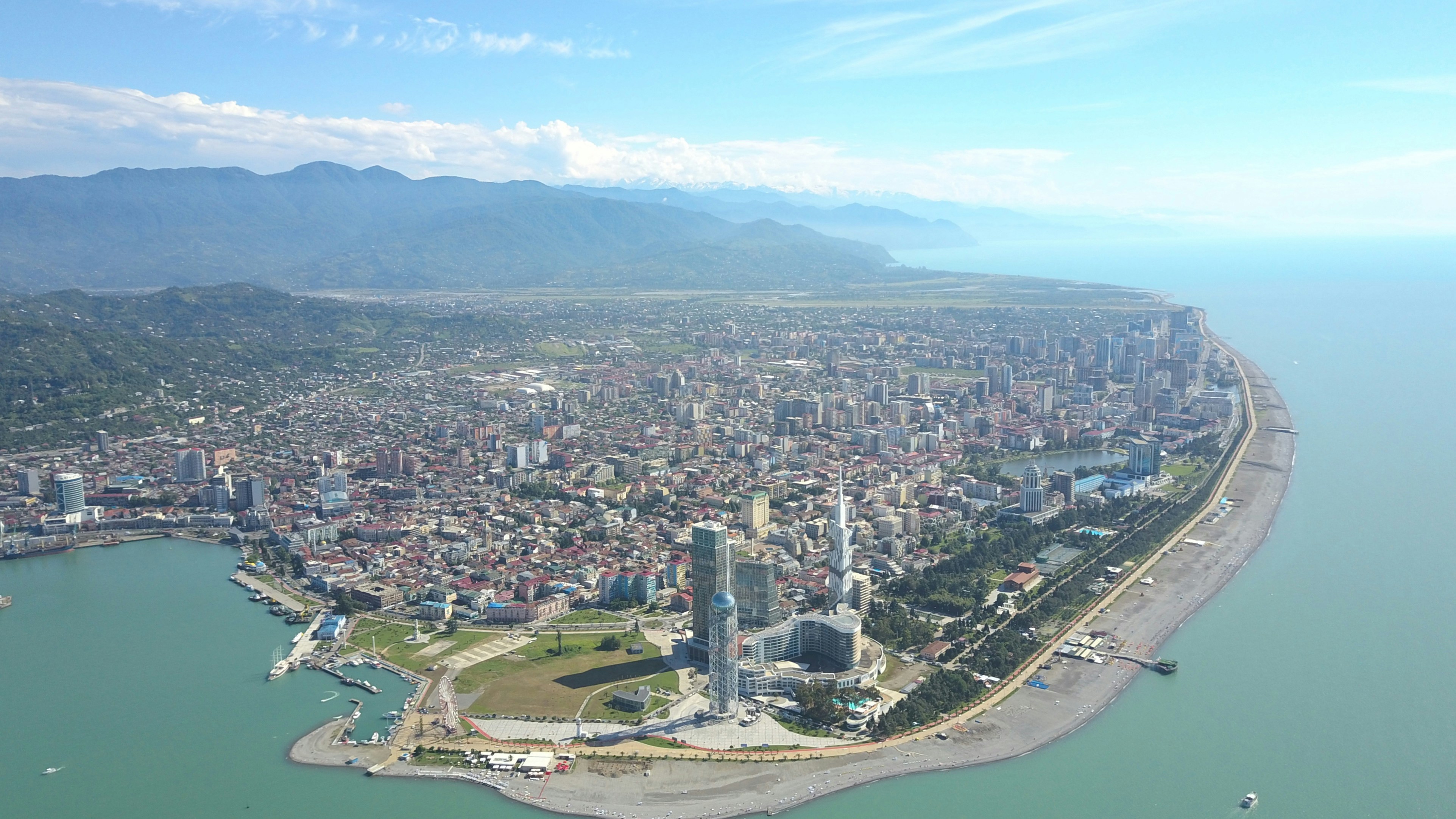
On the property side, the projects we select in Batumi deliver 8 to 12% net rental yield, with prices rising by 15 to 20% a year and entry tickets from 40,000 euros. Tbilisi, the capital, offers a different profile, driven by business and residential demand and by large international projects that are gradually reshaping its skyline.
Georgia is not a risk-free market. Like any emerging market, it requires thorough due diligence on projects, developers and legal structuring. That is precisely what we do for our clients: select solid projects, check title deeds and structure purchases correctly.
Switzerland and Singapore: banking centres for currency diversification
Opening an account with a Swiss or Singaporean bank is neither illegal nor reserved for the ultra-rich. It is a fully declarable and regulated form of banking diversification. At a time when some eurozone States must issue record amounts of debt and their bond yields are moving closer to those of the most fragile members, holding part of your liquidity in a jurisdiction with proven banking strength is not an excessive precaution.
Switzerland offers the legendary stability of the Swiss franc, tax-competitive cantons and a banking sector with a proven record in crisis management. Singapore offers an Asian financial hub, robust regulation and privileged access to Asia-Pacific markets, whose structural growth far exceeds that of Western Europe.
Building your plan: method and priorities
International diversification is not a leap into the unknown. It is a gradual process built step by step.
The first step is a complete review of your current situation: what is exposed, what is protected, and where risks are concentrated. The second is thinking about exit taxation, because some assets with large unrealised gains can trigger significant taxes when sold or transferred. Timing is crucial. The third is selecting destinations and vehicles according to your profile: time horizon, risk appetite, liquidity needs and family situation.
There is no universal solution. A business owner planning to sell their company in the coming years does not have the same needs as an executive preparing to retire abroad or an investor who simply wants to diversify their property holdings. These individual situations are what we analyse with each client before proposing a strategy.
Conclusion
Europe in 2026, with France as its most striking example, presents a macroeconomic and fiscal picture that its own institutions describe as worrying. This is not a value judgement on any country, its history or its people. It is a reading of the available data. Debt of 118% of GDP in the eurozone's second-largest economy, chronic deficits, some of the heaviest taxation in the world and recurring retroactive reforms on wealth: this context fully justifies not keeping all your assets in a single jurisdiction.
Dubai, Georgia, Swiss or Singaporean banking: these options exist, they are legal and accessible, and they can be structured to optimise both protection and performance. This is the structuring work we do, methodically and without haste, for the clients who trust us.
Would you like to analyse your situation and explore your international options?
We help investors structure their international wealth: review of the existing situation, choice of destinations, legal and tax structuring, banking support. The first conversation commits you to nothing.